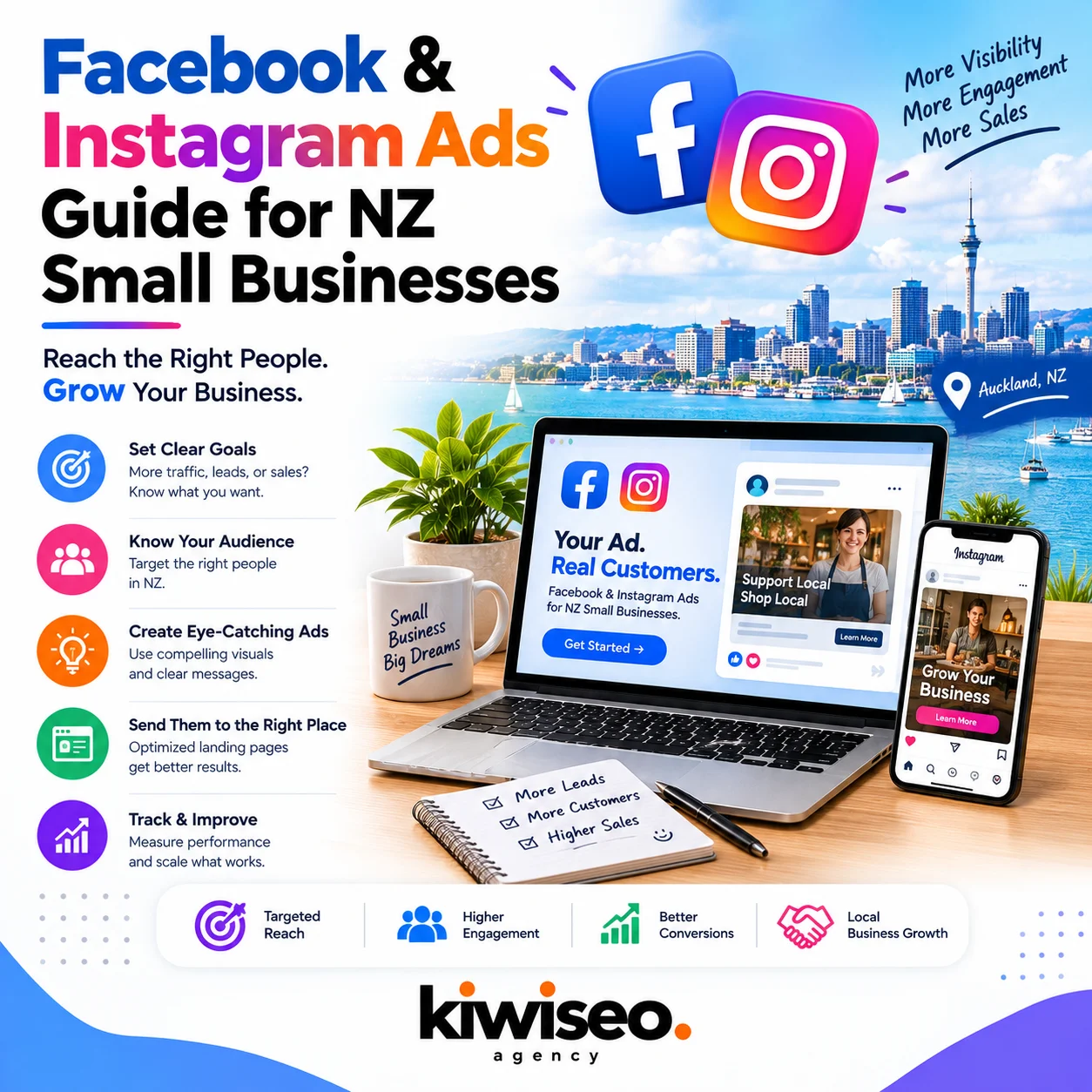
Most Facebook & Instagram ads campaigns run by New Zealand small business owners end the same way: a few hundred dollars spent, a handful of clicks, and no clear sense of what actually worked. That outcome is rarely a budget problem. It’s almost always a structure problem — the campaign was never set up to produce a clean, readable answer in the first place. Get the structure, targeting, and creative right before spending a dollar, and even a modest budget starts telling a business something genuinely useful.
Facebook and Instagram ads run through the same platform, Meta Ads Manager, and reach a genuinely large share of the country. Facebook alone had over 4.6 million users in New Zealand as of early 2026, representing roughly 88 percent of the total population, with the 25 to 34 age bracket the single largest group. For local services, product launches, seasonal offers, and remarketing to people who’ve already visited a website, Meta’s platforms remain one of the most cost-effective ways for a small business to reach an audience before that audience starts actively searching.
Why facebook & Instagram Ads still matter in 2026
The core distinction between Meta ads and Google Ads is worth understanding before spending anything. Search platforms capture intent that already exists — someone typing “plumber Auckland” has already decided they need a plumber. Meta platforms, by contrast, help create and convert intent by reaching people while they’re browsing, socializing, and discovering content, often before they’ve consciously identified a need at all.
This makes Meta ads particularly effective for local services building awareness, seasonal or limited-time offers, product launches, and remarketing campaigns aimed at warming up visitors who’ve already shown interest but haven’t converted yet. Organic reach on both platforms has been declining for years, which means paid advertising has become the realistic way most small businesses reach a meaningful audience, even a small, well-targeted one.
Understanding the three-layer campaign structure
Every Meta campaign is organised into three layers, and understanding this structure matters more than any individual setting, because it decides what usable data comes back at the end.
Campaign level is where a single objective is chosen — Awareness, Traffic, Leads, or Sales. One campaign should chase one goal only. Mixing objectives inside a single campaign muddies the results and gives Meta’s algorithm conflicting signals to optimise toward, which tends to produce mediocre performance against every goal rather than strong performance against one.
Ad set level is where audience targeting, placement, and budget are defined. This is where a business decides who sees the ad and how much gets spent reaching them.
Ad level is where the actual creative lives — the image, video, copy, and call to action a person actually sees. A single ad set can test multiple ad variations against the same audience to identify which creative performs best before scaling spend behind it.
Facebook vs Instagram: do you need both?
Both platforms run through the same Meta Ads Manager account and can be included in the same ad set, which means choosing between them is rarely an either-or decision in practice. Instagram tends to suit visual and lifestyle-driven brands — cafes, salons, fitness studios, fashion — while Facebook still reaches a broader and slightly older local audience, and remains genuinely influential in New Zealand specifically through Facebook Marketplace and suburb-level community groups like local “Buy/Sell/Swap” pages.
There’s also a regional pattern worth knowing. Instagram’s strongest organic and paid performance in New Zealand tends to concentrate in Auckland and Wellington, particularly for visually-driven niches like coffee, beauty, and fitness. A business operating outside those two cities, or in a less visual category, may find Facebook alone delivers more efficient results than splitting budget evenly across both platforms by default.
Setting a realistic budget
One of the more reassuring facts for a small business testing Meta ads for the first time: it’s possible to start with as little as $5 to $20 a day and still generate a meaningful signal, provided targeting and creative are solid. Many New Zealand small businesses run genuinely effective campaigns on $300 to $600 a month total.
The instinct to spend more per day to “speed things up” often backfires. Small businesses running tightly targeted $20-a-day campaigns with strong creative consistently outperform businesses spending ten times that with vague targeting and generic ad creative. Budget efficiency comes from precision, not raw spend.
A sensible way to structure a modest budget is splitting it across three purposes: a core budget for campaigns already proven to generate leads or sales, a smaller testing budget for new creative angles, offers, or audiences, and a retargeting budget sized to actual warm-traffic volume rather than an arbitrary percentage. A business with limited spend is usually better off concentrating budget on one qualified campaign than spreading thin money across four ad sets that never individually gather enough data to be useful.
Getting targeting right
Meta’s targeting tools allow a business to narrow an audience by demographics, interests, and behaviours, but the platform’s own guidance for new advertisers is to start broad and let the algorithm optimise from there, rather than narrowing too aggressively before there’s any performance data to work from. For a genuinely new business with no existing customer data, this broad-first approach is usually the right call, since it gives the algorithm room to learn who actually responds before targeting gets refined.
New Zealand’s population is comparatively small and regionally concentrated, which changes how targeting behaves compared to larger markets. Audiences narrow down quickly, and an ad set targeted too tightly in a smaller city can exhaust its available audience within days, driving costs up as the algorithm struggles to find new people to show the ad to. Keeping initial targeting a little broader than instinct suggests is usually the safer starting point in the New Zealand market specifically.
Creative that actually stops the scroll
Unlike search ads, which compete against a list of blue links, Meta ads compete against a feed full of friends’ updates, video, and other brands, all moving fast. The image or video needs to interrupt that scroll immediately. Bold colours, unusual compositions, or visuals that break the pattern of typical feed content all help, and keeping on-image text minimal continues to perform better even though Meta’s older strict penalties for text-heavy images have relaxed somewhat by 2026.
Feed ads support longer captions than Stories, and the first line matters disproportionately, since it’s the only text visible before a “see more” cutoff. That first line needs to hook attention on its own before the value proposition and call to action follow. Stories ads, meanwhile, work particularly well for local businesses through location tags and swipe-up actions that drive foot traffic directly to a physical location.
If a campaign’s click-through rate sits below roughly 0.5 percent, the problem is almost always the creative rather than the audience. Before adjusting targeting or increasing budget, it’s usually worth testing new ad variations first.
How long before results are trustworthy
Patience matters more than most beginner guides admit. A new ad set needs at minimum four to five days to exit Meta’s “learning phase,” during which the algorithm is still gathering signal on who responds best. Judging performance before that window closes almost always produces a misleading picture. Meaningful trend data generally takes two to three weeks of consistent, unchanged delivery, which means resisting the urge to pause or drastically edit a campaign every few days is often the single highest-leverage discipline a small business owner can apply.
Compliance: what NZ businesses need to know
New Zealand’s Fair Trading Act applies to advertising on Meta platforms the same way it applies anywhere else. Testimonials used in ad creative must be genuine, attributable to a real customer, and not materially misleading about the results a typical customer can expect. A business featuring a customer quote or before-and-after result in an ad needs to be confident that testimonial reflects a realistic outcome, not a best-case exception presented as the norm.
Common mistakes that quietly waste ad spend
A handful of avoidable mistakes account for most of the wasted budget seen in first-time Meta campaigns. The most common is editing a live campaign too frequently — adjusting budget, audience, or creative every day or two resets the learning phase each time, meaning the algorithm never accumulates enough signal to actually optimise delivery. A campaign edited constantly in its first week rarely outperforms one left alone.
Another frequent issue is sending ad traffic to a generic homepage rather than a page built specifically around the offer in the ad. A visitor who clicks an ad for a specific promotion, then lands on a general homepage with no clear next step, converts at a fraction of the rate of someone landing on a page built around that exact offer. This mismatch between ad and landing page is one of the most common reasons a campaign generates clicks but few actual leads or sales.
Poor tracking setup is a third quiet cost. Without the Meta Pixel or Conversions API correctly installed, a business loses visibility into which ads are actually driving purchases or enquiries versus which are simply generating cheap, low-value clicks. This also weakens the algorithm’s ability to optimise delivery toward people likely to convert, since it has no reliable signal telling it who actually became a customer after clicking.
Finally, many small businesses treat their first campaign as a one-off test rather than the start of an ongoing process. The real value of Meta advertising compounds over successive campaigns, as creative learnings, audience data, and retargeting pools build up over time. A business that runs one campaign, judges it in isolation, and walks away rarely sees the same return as one that treats early campaigns as the foundation for progressively sharper targeting and creative down the line.
Getting started without wasting the first month
For a small business running Meta ads for the first time, the fastest path to a useful result usually looks like this: pick one clear objective for the first campaign rather than trying to cover awareness and sales at once, start with a broader audience than instinct suggests, prepare two or three genuinely different creative variations rather than one polished ad, and commit to leaving the campaign untouched for at least the first week while it exits the learning phase.
The businesses that get real value from Meta ads treat the first month as a structured test, not a bet on making back the spend immediately. The data that comes back from a clean, well-structured first campaign, even a modest one, is usually worth more than the leads it generates directly, since it tells a business exactly where to put the next dollar with far more confidence than guessing ever could.
FAQs
How much should a small NZ business spend on Facebook and Instagram ads?
Many New Zealand small businesses run effective campaigns on $300 to $600 a month, and it’s possible to start testing with as little as $5 to $20 a day. Precise targeting and strong creative matter more than raw budget size.
Should I advertise on Facebook or Instagram first?
Both run through the same Meta Ads Manager account, so it’s rarely an either-or choice. Instagram tends to suit visual, lifestyle-driven brands, especially in Auckland and Wellington, while Facebook reaches a broader, slightly older audience and remains strong for local community reach across New Zealand.
How long before I know if a Facebook ad campaign is working?
Allow at least four to five days for a new ad set to exit Meta’s learning phase, and expect two to three weeks of consistent delivery before trend data becomes genuinely reliable. Judging results earlier than that usually gives a misleading picture.
Why is my click-through rate so low?
A click-through rate below roughly 0.5 percent almost always points to a creative problem rather than a targeting problem. Testing new ad images, video, or copy is usually the first fix to try before adjusting the audience.
Do I need a professional to run Facebook and Instagram ads for my business?
A small, well-structured campaign can be run in-house, particularly at a modest budget. As spend and complexity grow, working with a specialist becomes more valuable for structuring campaigns correctly, avoiding wasted learning-phase spend, and reading Ads Manager data the way a performance marketer would rather than as a casual user.