
Ask five agencies how much digital marketing cost nz and you’ll likely get five different numbers, because there genuinely isn’t one figure that applies to every business. A solo tradesperson running local Google Ads and a fifty-person SaaS company running SEO, paid media, content, and email simultaneously are not buying the same thing, even though both fall under “digital marketing.” What follows is a realistic breakdown of what businesses actually pay in New Zealand in 2026, by channel and by pricing model, so a quote can be judged against real numbers rather than guesswork.
The short answer
There is no single price that applies to every New Zealand business, and costs can range from several hundred dollars a month for a focused, single-channel service up to several thousand for a broader, multi-channel strategy. The right number depends on the business’s size, competition, goals, and which services are actually needed, not a flat industry rate.
Digital Marketing Cost NZ: How Agencies Actually Charge
Most New Zealand digital marketing pricing falls into four models, and understanding which one a quote is built on matters more than the headline number itself.
Monthly retainers are the most common structure, covering an agreed scope of ongoing work for a fixed fee each month. Project fees apply to defined, one-off builds like a new website or brand campaign. Hourly rates suit bounded, ad-hoc work such as analytics setup or a technical SEO fix. Percentage of ad spend is common specifically for paid media management, usually with a minimum monthly fee attached regardless of how much is spent on ads.
On hourly work, freelancers in New Zealand typically charge between $50 and $120 an hour, while agencies charge $95 to $200 depending on seniority and location. A quote well below that range is worth a second look, since it usually signals junior-level delivery rather than genuine efficiency.
What a monthly retainer costs
Retainer pricing scales heavily with how many channels are included and how senior the team running them is.
A single channel managed properly, such as Google Ads or basic local SEO, typically runs $500 to $1,500 a month, which is the realistic entry point for a small trades or services business testing one channel at a time. Once a business needs two or three channels working together, pricing generally moves into the $1,500 to $4,000 range, and full-service engagements spanning SEO, paid media, content, and reporting commonly land between $4,000 and $10,000 or more per month.
That range lines up closely with figures reported elsewhere in the market. Full-service retainers in New Zealand typically sit between $3,000 and $10,000 a month, though the exact figure shifts based on strategic depth, reporting standards, and how often the agency communicates with the client. For early-stage businesses specifically wanting genuine senior-level strategic input rather than junior execution, budgeting $2,000 to $5,000 a month is a more realistic starting point, since anything meaningfully lower tends to mean limited strategic oversight.
Typical cost by channel
Breaking the total down by individual service makes it easier to see where a retainer’s budget is actually going:
- Google Ads or paid media management: commonly $300 to $1,500 a month as a flat fee, or 10 to 20 percent of ad spend, plus the ad spend itself
- Local SEO or Google Business Profile optimisation: roughly $380 to $780 a month for a focused, single-location setup
- Full SEO campaigns: typically $540 to $2,580 a month depending on competitiveness and scope
- Social media marketing: generally $1,500 to $5,000 a month for most small to medium businesses, varying by platform count, posting frequency, and whether professional photo or video production is included
- Email marketing: around $300 to $580 a month for ongoing campaign management
- Website builds: $1,500 to $3,500 for a templated site, or $4,500 to $15,000 and up for a fully custom build
Ad spend itself sits separate from management fees. As a practical floor, budgeting at least $1,000 a month in actual ad spend, on top of management fees, is generally needed to generate enough data for a campaign to produce useful results.
What percentage of revenue should go to marketing
For businesses working out a budget from the top down rather than channel by channel, revenue-based benchmarks offer a useful sanity check. Most New Zealand small businesses should allocate somewhere between 5 and 12 percent of gross revenue to total marketing, with digital channels making up the majority of that spend. Within that range, an established business operating in a low-competition market can often sit toward the lower end, around 5 to 7 percent of revenue, while a business pushing for growth or entering a more competitive market typically needs to budget higher.
A starter budget of $500 to $1,500 a month tends to suit a local business focused on one or two channels, while growth-stage businesses generally invest $2,000 to $5,000 a month spread across multiple channels. The most common budgeting mistake isn’t spending too little overall, it’s spreading too little money across too many channels at once, which leaves every channel underfunded and none of them able to produce a meaningful result.
Why quotes vary so much for the “same” service
Two agencies quoting for what looks like identical scope can land far apart in price for reasons that rarely show up in a one-line proposal. Seniority of the team actually doing the work is the biggest factor: a quote built around a junior account manager and a template process will always undercut one built around a strategist with years of industry-specific experience. Reporting depth matters too, since a basic monthly dashboard costs far less to produce than custom reporting tied to actual revenue outcomes.
Whether ad spend is included in the headline number is another common source of confusion. A $1,500 quote that excludes media spend and a $1,500 quote that includes it are not comparable offers, even though they read identically on paper. The safest approach is asking directly what the fee covers, what’s billed separately, and who on the team will actually be doing the work, before comparing any two numbers side by side.
Hidden costs that don’t show up in the headline quote
The number on a proposal is rarely the full number a business ends up paying each month. Software and tool subscriptions are one of the most commonly missed costs — SEO platforms, ad tracking software, email marketing tools, and reporting dashboards often get billed separately from the management fee, and some agencies pass these costs through directly rather than absorbing them into the retainer.
Setup and onboarding fees are another frequent surprise. A first month often costs more than subsequent months because of account audits, tracking implementation, competitor research, and campaign structure work that only needs to happen once. A business comparing a $1,500 quote against a $2,000 quote without asking whether either figure includes a one-off setup fee is comparing incomplete numbers.
Creative production is a third gap. Social media and paid ads retainers frequently exclude photography, video, and graphic design, treating these as add-ons priced per asset or per shoot. A retainer that looks affordable can quietly double once a business realises ongoing content needs professional visuals the management fee never covered.
Finally, contract length and cancellation terms affect the real cost of switching if a partnership isn’t working. Some NZ agencies lock clients into six or twelve month minimum terms, while others run month to month. A lower monthly rate tied to a long minimum commitment isn’t necessarily cheaper than a slightly higher rate with more flexibility, particularly for a business still working out which channels actually perform.
What different business types typically spend
Pricing benchmarks land differently depending on the type of business asking. A local trades business, such as a plumber or electrician competing mainly on local search and reviews, generally spends toward the lower end of the range, often $500 to $1,500 a month on local SEO and Google Ads combined, since the competitive set is smaller and geographically bound.
A retail or ecommerce business usually needs a wider spread across channels — SEO, paid shopping ads, email, and social — and commonly sits in the $2,000 to $5,000 a month range once all channels are running together, with additional ad spend on top of management fees.
A B2B or professional services business, such as an accounting firm or a software company, often has a longer sales cycle and a smaller but higher value pool of potential customers. These businesses frequently spend more per lead but pursue fewer total leads, and budgets in the $3,000 to $8,000 a month range aren’t unusual once content marketing, SEO, and LinkedIn advertising are combined to support a longer nurture process.
Questions worth asking before signing a proposal
A handful of direct questions tend to expose exactly where a quote’s real cost sits, before a contract is signed rather than after the first invoice arrives. Is ad spend included in this number, or billed separately? Who specifically will be working on the account day to day, and how senior are they? Is there a setup fee in month one that won’t repeat? What’s the minimum contract term, and what happens if the relationship isn’t working after three months? What reporting will actually be delivered, and how often?
None of these questions are confrontational to ask, and any agency confident in its pricing should be able to answer all five clearly and immediately. Hesitation or vague answers on any of them is usually the clearest signal available before work even begins.
Channel choice affects not just cost but also how quickly a business sees a return. SEO generally delivers the strongest long-term return on investment for most New Zealand businesses, but it requires three to six months of consistent investment before it starts generating meaningful results. Google Ads and Meta Ads, by contrast, produce faster results but require ongoing spend to sustain them, since traffic and leads drop off almost immediately once the budget stops.
This is why many New Zealand businesses run both in parallel rather than choosing one. Paid media covers the gap while SEO compounds in the background, and by the time ad spend efficiency starts to plateau, organic traffic has usually built up enough to reduce reliance on paid channels altogether.
What actually determines the right number for your business
Rather than chasing an industry average, the more useful exercise is working backwards from a few specific questions: how many channels genuinely need to run at once, how competitive the industry is in New Zealand specifically, whether the business needs senior strategic input or straightforward execution of an already-clear plan, and what a realistic three-to-six-month runway looks like before results are expected.
A business spending $800 a month on a single well-run channel and a business spending $8,000 a month across five channels can both be spending appropriately, provided the spend actually matches what the business needs at its current stage. The mistake isn’t spending a particular amount; it’s spending without first being clear on what that spend is supposed to achieve.
FAQs
What is the average cost of digital marketing in NZ?
Most New Zealand businesses spend between $500 and $10,000 a month, depending on how many channels are involved and the seniority of the team managing them. A single-channel setup for a small business typically starts around $500 to $1,500 a month.
How much should a small business spend on digital marketing in NZ?
Most small businesses should budget 5 to 12 percent of gross revenue toward marketing, with the majority allocated to digital channels. A starter budget of $500 to $1,500 a month is realistic for one or two focused channels.
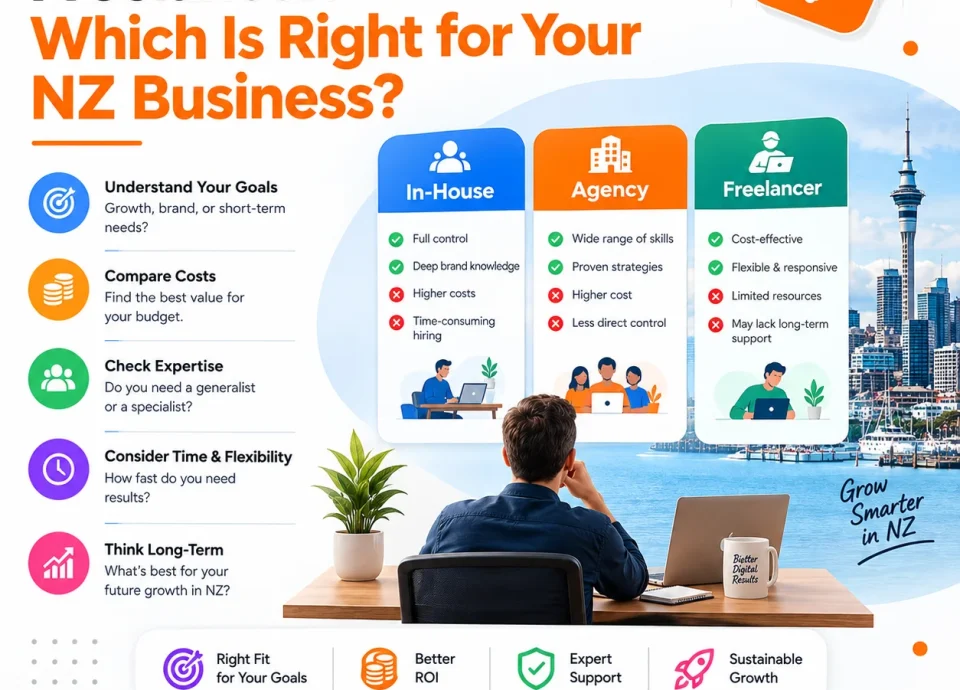
Is it cheaper to hire a freelancer or an agency in NZ?
Freelancers typically charge $50 to $120 an hour, lower than an agency’s $95 to $200, but a freelancer usually covers one channel rather than a coordinated multi-channel strategy. For narrow, well-defined tasks a freelancer is usually cheaper; for ongoing multi-channel management, an agency retainer often works out more cost-effective overall.
How much does SEO cost per month in NZ?
Full SEO campaigns in New Zealand typically cost $540 to $2,580 a month, depending on competitiveness, while basic local SEO or Google Business Profile work runs lower, around $380 to $780 a month.
Does the quoted price include ad spend?
Not always, and this is the single biggest source of confusion when comparing quotes. Some agencies quote a management fee only, with ad spend billed separately, while others bundle both into one number. Always ask explicitly what a quote does and doesn’t include before comparing it to another agency’s price.