Picture an Auckland dentist. Good website, decent prices, a genuinely great team — and they’re sitting on page two while the practice down the road, with worse reviews and an uglier site, owns the top three spots in the Map Pack. It isn’t bad luck. It’s order of operations. This local SEO guide walks through exactly what determines Google Maps rankings in Auckland, and the sequence that gets a business into that top three fastest.
The opportunity here is bigger than most business owners realise. Local searches now make up roughly 46 percent of all Google searches, and 76 percent of people visit a business within a day of searching for it locally. When someone in Mt Eden searches “electrician Mt Eden,” they see three businesses in the Map Pack with ratings and photos, tap through to scan a website, read a couple of reviews, and call within the hour. That’s the entire buying journey, and a business that isn’t visible in that moment simply doesn’t exist to that customer.
What local SEO actually is
Local SEO is the process of optimising a business’s online presence so it ranks in Google’s Map Pack — the block of three businesses with a map that appears above the regular organic results — and in location-based organic search for queries like “plumber Auckland CBD” or “accountant North Shore.” It’s distinct from general SEO in that it’s built entirely around proximity and local relevance rather than broad topical authority.
The Map Pack matters disproportionately because of where clicks actually go: roughly 42 percent of local searchers click a result inside the Map Pack itself, ahead of anything in the standard organic listings below it. Ranking well in organic search without also ranking in the Map Pack still leaves a business missing the bulk of local click volume.
How Google actually ranks local results
Google has been consistent about this for years: local rankings come down to three factors — relevance, distance, and prominence. Understanding each one is the difference between guessing at local SEO and actually working through it methodically.
Relevance is how well a business matches what someone is searching for. Google reads this from Google Business Profile categories, the content on the website itself, and how clearly the business describes what it does. A business calling itself a general café that occasionally serves pasta won’t rank for “Italian restaurant Auckland CBD” the way an actual Italian restaurant will, regardless of how good the food is.
Distance measures how close a business is to the searcher, or to the location implied in the search itself. This is the one factor a business has essentially no control over, since it’s calculated automatically based on the searcher’s location or the location terms used in their query.
Prominence reflects how well-known and well-regarded a business is, both online and off. This is the factor that gives businesses the most room to actively improve, and it’s built from review volume and quality, citation consistency, backlinks, and overall engagement with the listing.
Get all three broadly right and a business shows up first. Miss one badly enough and it gets pushed down, or filtered out of the Map Pack entirely, however good the business actually is in person.
Step one: build a complete Google Business Profile
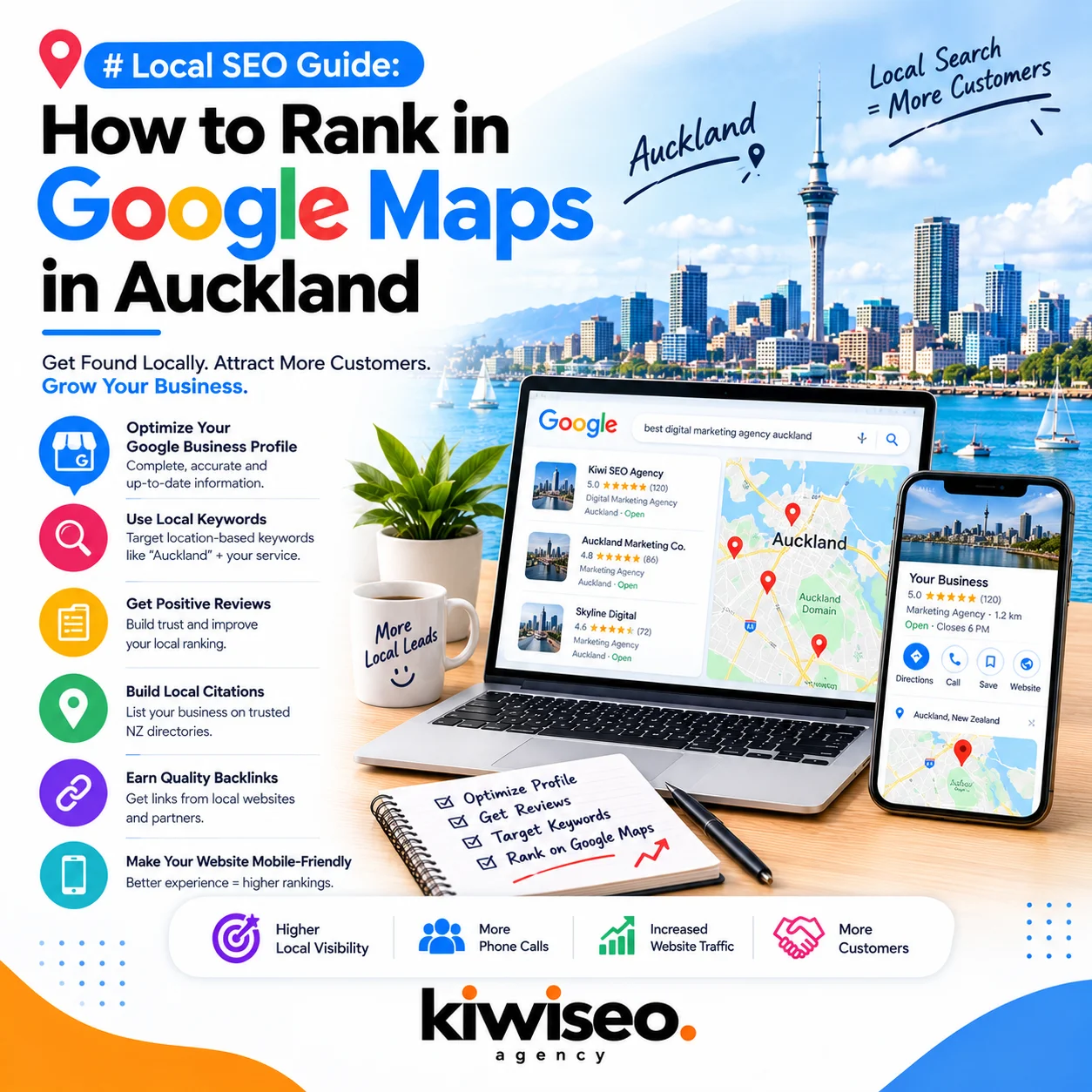
The Google Business Profile is the single most important asset in local SEO, and it’s free. It’s also the piece most Auckland businesses get wrong, not through neglect exactly, but through leaving it half-finished. A profile with missing categories, no recent photos, or an incomplete services list gives Google too little information to fully understand the business, and an incompletely understood business simply doesn’t get ranked, no matter how good it actually is.
The opportunity here is larger than most owners assume. Only around 35 percent of small and medium businesses even have a fully set-up Google Business Profile, meaning roughly two-thirds of the competitive field hasn’t done the basics properly. Google’s own data shows customers are 70 percent more likely to visit a business with a complete profile, and 2.7 times more likely to consider it reputable.
Getting the profile right means starting with the real, legal business name — not a keyword-stuffed version like “Plumber Auckland – Best Service,” which risks the listing being suspended entirely. The primary category is one of the single strongest ranking factors available, so it deserves real thought rather than a quick default choice. From there, the services list should start with the obvious core offering and expand to cover specific jobs customers actually search for: a plumber benefits from listing not just “plumbing” but “blocked drain Auckland” and “hot water cylinder repair” as distinct services, since these map directly onto how real searchers phrase their problems.
Photos, accurate opening hours, and an active posting habit round out a strong profile. None of this is complicated work; it’s simply thorough work that most competitors haven’t bothered finishing.
Step two: build review volume and respond to every one
Reviews function as a prominence signal Google weighs heavily, and they’re also the first thing a human searcher checks before calling. In most competitive Auckland industries, 50 or more reviews with a rating above 4.5 stars is roughly what it takes to be competitive in the Map Pack. Total count matters less than consistency, though — aiming for three to five new reviews a month tends to outperform a single burst of twenty reviews followed by months of silence, since Google’s algorithm appears to favour steady, ongoing review activity over a one-off spike.
Responding to every review, positive and negative, is worth the small amount of time it takes. It signals an active, engaged business to both Google and to prospective customers reading through the list before deciding who to call.
Step three: fix citation consistency
A citation is any online mention of a business’s name, address, and phone number, whether on a directory, another business’s site, or a review platform. Google cross-references these mentions to verify a business is legitimate and correctly located, and inconsistencies between them, a slightly different phone number here, an old address there, actively undermine trust in the listing. Fixing these inconsistencies as soon as they’re spotted matters more than most business owners assume, since Google appears to treat unresolved citation conflicts as a signal the business information can’t be fully trusted.
Step four: build location-relevant website content
Auckland is a sprawling market of 1.7 million people spread across dozens of distinct suburbs, each with its own local search patterns. A business serving multiple areas benefits from dedicated pages built around each one, provided each page offers genuinely useful, specific content rather than a copy-pasted template with only the suburb name swapped out. Google penalises thin, duplicate location pages, so a Ponsonby page and a Mt Eden page need to actually differ in substance, not just in the place name sitting at the top.
Adding Local Business schema markup to a website also helps Google parse exactly what the business is, where it operates, and how to contact it, reinforcing the same signals already present in the Google Business Profile rather than leaving Google to infer them separately from unstructured page content.
The order that actually gets results fastest
Every local SEO guide hands over roughly the same checklist: profile, reviews, citations, content. What most skip is the order that produces results fastest. The sequence generally runs Google Business Profile first, since it’s the foundation everything else builds on, then reviews, then citations, then location pages, then broader content and local link building. Doing the highest-impact steps first, rather than working through the list in whatever order feels comfortable, is often the actual difference between a business that sees movement within weeks and one that spends months on lower-impact work first.
What this looks like for a determined business owner
Most of this work is genuinely doable without outside help. The steps themselves are simple, most of the tools involved are cheap or free, and a determined owner with a few weekends of focused effort can realistically claim the Map Pack in a quieter, less competitive niche. Where it gets harder is in Auckland’s genuinely competitive categories, a dentist in the central city, a lawyer downtown, where every competitor is already running the same playbook and the gap comes down to who executes it more sharply and consistently, not who discovers some secret tactic nobody else knows.
Why local SEO compounds in a way paid ads don’t
The lasting appeal of local SEO Guide over paid alternatives is what happens once the ranking is actually earned. A strong local SEO foundation keeps producing enquiries long after the initial setup work is done, without an ongoing per-click cost attached the way paid ads carry one. It’s a genuinely compounding asset: consistency and steady optimisation over time make an established local listing increasingly difficult for a new competitor to dislodge, since they’re not just competing against a website anymore, they’re competing against months or years of accumulated reviews, citations, and engagement history.
Common mistakes that quietly cap rankings
A few recurring mistakes hold otherwise solid Auckland businesses back in the Map Pack. Keyword-stuffing the business name is one of the most damaging, since Google actively penalises this practice and can suspend a listing entirely for it, wiping out visibility completely rather than just capping it. Choosing the wrong primary category is a subtler version of the same problem — a business that picks a broad, generic category instead of the most specific one available loses relevance signal it never needed to give up.
Letting the profile go stale is another quiet cost. A Google Business Profile with no new photos, no recent posts, and hours that haven’t been checked in over a year signals inactivity to Google, even if the business itself is thriving. The fix costs nothing beyond a few minutes a month, but it’s routinely skipped once the initial setup is done.
Ignoring negative reviews rather than responding to them is a mistake with a real cost attached. A thoughtful, professional response to a negative review often does more for prospective customer trust than the negative review itself does damage, while an unanswered negative review left sitting for months signals a business that isn’t actively engaged with its own reputation.
Finally, treating local SEO Guide as a one-off project rather than an ongoing habit is probably the most common mistake of all. A profile fully optimised once and never touched again gradually loses ground to competitors who keep adding reviews, refreshing photos, and posting updates. Local SEO rewards consistency more than any single burst of initial effort, however thorough that effort was.
FAQs
How long does it take to rank in Google Maps in Auckland?
Timelines vary by competition level, but most Auckland businesses see meaningful Map Pack movement within a few months of a properly completed Google Business Profile, consistent review growth, and clean citations. Highly competitive categories in the central city typically take longer than quieter suburban niches.
How many Google reviews do I need to rank in Auckland?
In most competitive Auckland industries, 50 or more reviews with a rating above 4.5 stars is roughly the competitive benchmark, though this varies by category. Consistency matters more than volume alone — aim for three to five new reviews a month rather than one large burst.
What’s the single most important local SEO factor?
The Google Business Profile is the single most important asset in local SEO, since it directly feeds the Map Pack with location, services, hours, reviews, and photos. Without a complete, verified profile, ranking in the Map Pack at all is essentially impossible.
Can I do local SEO myself, or do I need an agency?
Much of the foundational work, profile completion, review requests, citation cleanup, is realistically doable without professional help. Competitive categories in central Auckland, where every business is already running the same playbook, tend to benefit more from specialist execution to close the remaining gap.
Does local SEO Guide still matter with AI-powered search on the rise?
Yes. A well-optimised local presence increasingly gets pulled into AI-generated search summaries as a cited source, which means the same fundamentals, an accurate, complete, well-reviewed profile, matter for AI visibility as much as they do for traditional Map Pack rankings.