
Digital marketing is the practice of promoting a business through internet-based channels such as search engines, social media, email, and paid advertising, instead of relying on print, radio, or television. It covers five core disciplines: SEO, Google Ads (PPC), social media marketing, email marketing, and content marketing. Each channel targets a different stage of the buyer journey, from someone first noticing your brand to someone ready to hand over their card details. For an Auckland business competing against dozens of local rivals on Google Maps and Instagram alike, digital marketing isn’t a nice-to-have anymore. It’s the main way customers find you, compare you, and decide whether to trust you.
This guide breaks down what digital marketing actually means, the channels that make it up, how NZ businesses typically use it, and how to know if it’s working. By the end, you’ll understand enough to have an informed conversation with an agency, a freelancer, or your own in-house team about where to start.
What Does Digital Marketing Mean in Simple Words?
Digital marketing means using online tools to reach the people most likely to buy from you. That’s the whole idea, stripped of jargon. A billboard on the motorway reaches everyone who drives past, whether they need your product or not. A Google Ad for “plumber Auckland” only reaches someone who typed that exact phrase because their pipe just burst. That’s the fundamental shift digital marketing brought to advertising: precision.
Auckland Council’s own small business data shows a similar pattern to what we see at Kiwi SEO Agency across almost every Auckland client we work with. Local search behaviour is where most buying decisions now start, well before a phone call or a store visit happens. A customer researches, compares reviews, checks a website, and often makes up their mind before they ever speak to a salesperson.
Digital marketing sits under a broader umbrella that includes SEO (organic visibility), Google Ads (paid visibility), social media (brand presence and community), email marketing (direct communication with people who already know you), and content marketing (blog posts, guides, and videos that answer questions your customers are asking). None of these work in total isolation. A blog post supports SEO. An email list often grows from social media followers. A Google Ad can lead to a landing page written using content marketing principles. The channels overlap, and that overlap is exactly why a scattered, one-channel approach tends to underperform.
The Main Types of Digital Marketing
Search Engine Optimization (SEO)
SEO is the process of improving a website so it ranks higher in Google’s organic (unpaid) search results. It splits into three areas: technical SEO (site speed, mobile usability, crawlability), on-page SEO (content, titles, headings, internal links), and off-page SEO (backlinks and brand mentions from other sites). SEO takes longer to show results than paid ads, usually three to six months for early movement, but it compounds over time and doesn’t stop working the moment you pause spending, unlike ads.
Google Ads (PPC)
Google Ads, sometimes called PPC (pay-per-click), lets a business bid to appear at the top of search results for chosen keywords. You only pay when someone clicks. It’s the fastest way to get in front of buyers with strong intent, someone searching “emergency electrician Auckland” at 9pm is about as close to ready-to-buy as search traffic gets. The trade-off is straightforward: traffic stops the day the budget does.
Social Media Marketing
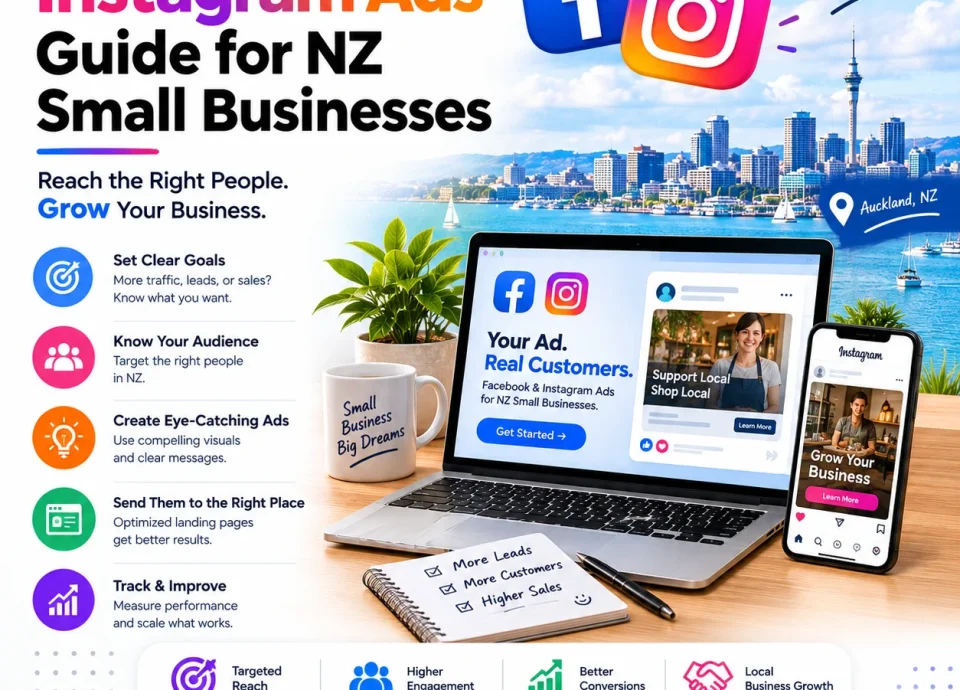
Social media marketing covers both organic content (posts, Reels, Stories) and paid advertising on platforms like Facebook, Instagram, LinkedIn, and TikTok. It’s less about immediate conversions and more about staying visible, building trust, and giving a brand a personality. A well-run Facebook or Instagram Ads campaign can also drive direct leads, particularly for retail and hospitality businesses with a visual product.
Email Marketing
Email marketing is the channel a business owns outright. Nobody’s algorithm decides who sees your email, unlike social media reach, which platforms constantly throttle. It’s used for newsletters, promotions, abandoned cart follow-ups, and nurturing leads who aren’t ready to buy yet. Despite being one of the oldest digital channels, email consistently delivers one of the strongest returns per dollar spent because the audience already opted in.
Content Marketing
Content marketing means creating genuinely useful material, blog posts, guides, videos, case studies, that answers questions your audience is already asking. It supports SEO (Google rewards sites that answer questions thoroughly), builds authority, and gives you something worth sharing on social media and in emails. Done well, it turns a website from a digital brochure into a resource people actually return to.
Why Digital Marketing Matters for Small Businesses in NZ
Small businesses in Auckland and across NZ are competing against national chains, Australian entrants, and each other, often on the exact same search terms. A local business without a digital presence effectively hands that visibility to whoever shows up instead. That’s the practical reason digital marketing matters: it’s not really about “being online” in the abstract, it’s about being findable at the exact moment someone nearby needs what you sell.
There’s also a budget argument that favours smaller operators more than people expect. A billboard campaign costs roughly the same whether it reaches 10 buyers or none. A Google Ads campaign spends nothing until someone actually clicks, and you can pause it within minutes if it’s not converting. That level of control simply didn’t exist before digital channels, and it’s part of why even single-person trades businesses now run PPC campaigns that would have been unthinkable through traditional media a decade ago.
Digital marketing also levels a different kind of playing field: measurement. A small Auckland cafe can see exactly how many people clicked their Google Ad, how long they stayed on the menu page, and whether that turned into a booking. A national brand running a TV ad gets none of that granularity. For a business owner watching every dollar, that visibility into what’s actually working (and what isn’t) is often more valuable than the traffic itself.
How Digital Marketing Channels Work Together
The biggest mistake businesses make is treating each channel as a separate project instead of parts of one system. SEO and content marketing feed each other, a blog post written to answer a real customer question is also the exact content Google wants to rank. Google Ads and SEO often get pitted against each other, but running both means you occupy more space on the results page while SEO climbs in the background. Social media builds the audience that email marketing later nurtures. None of these channels replace the others. They compound.
A typical sequence for a growing Auckland business looks something like this: Google Ads generates leads immediately while SEO is still building. Social media keeps the brand visible between purchases. Email marketing turns first-time buyers into repeat customers without any extra ad spend. Content marketing feeds both SEO and the material shared across social and email. Each channel does a job the others can’t do as efficiently, which is why most established agencies build campaigns across two or three channels at minimum rather than betting everything on one.
How to Measure Digital Marketing Performance
Every channel has its own key metrics, but a few matter across the board. Return on investment (ROI) measures the revenue generated against what was spent, the number that ultimately decides whether a channel is worth continuing. Conversion rate tracks the percentage of visitors who complete a desired action, whether that’s a purchase, a form submission, or a phone call. Cost per acquisition (CPA) shows how much it costs to win one new customer, useful for comparing channels directly against each other. Return on ad spend (ROAS) is the paid-media equivalent of ROI, specifically measuring revenue against ad spend rather than total marketing cost.
Google Analytics 4 (GA4) and Google Search Console remain the two free tools most NZ businesses rely on for tracking this data, alongside native reporting inside Google Ads and Meta’s Ads Manager. None of these numbers matter in isolation. A high click-through rate with no conversions usually points to a mismatch between the ad and the landing page, not a failing campaign. Reading these metrics together, rather than chasing any single number, is what separates a campaign that’s genuinely working from one that just looks busy.
Common Digital Marketing Mistakes to Avoid
Most underperforming campaigns share the same handful of problems. Spreading a small budget across five channels at once, rather than doing one or two properly, dilutes results everywhere. Treating SEO like a one-off task instead of an ongoing process is another common trap, algorithms shift, competitors publish new content, and a site that isn’t maintained slowly loses ground even without doing anything visibly wrong. Running Google Ads without conversion tracking set up means flying blind on what’s actually working. And skipping a proper strategy in favour of “just posting” on social media tends to produce content with no clear goal and, unsurprisingly, no measurable return.
The fix for most of these isn’t more budget. It’s narrower focus: pick the one or two channels that match how your specific customers actually search and buy, set up proper tracking from day one, and give each channel enough time to show real data before switching direction.
Frequently Asked Questions
What is digital marketing in simple terms?
Digital marketing is promoting a business through online channels, search engines, social media, email, and paid ads, rather than through print, radio, or TV. It lets businesses target the specific people likely to buy, rather than broadcasting to everyone.
What are the 5 main types of digital marketing?
The five core types are SEO, Google Ads (PPC), social media marketing, email marketing, and content marketing. Most effective campaigns combine at least two or three of these rather than relying on just one.
Is digital marketing the same as social media marketing?
No. Social media marketing is just one channel within digital marketing. Digital marketing is the broader category that also includes SEO, paid search, email, and content.
How much does digital marketing cost for a small business in NZ?
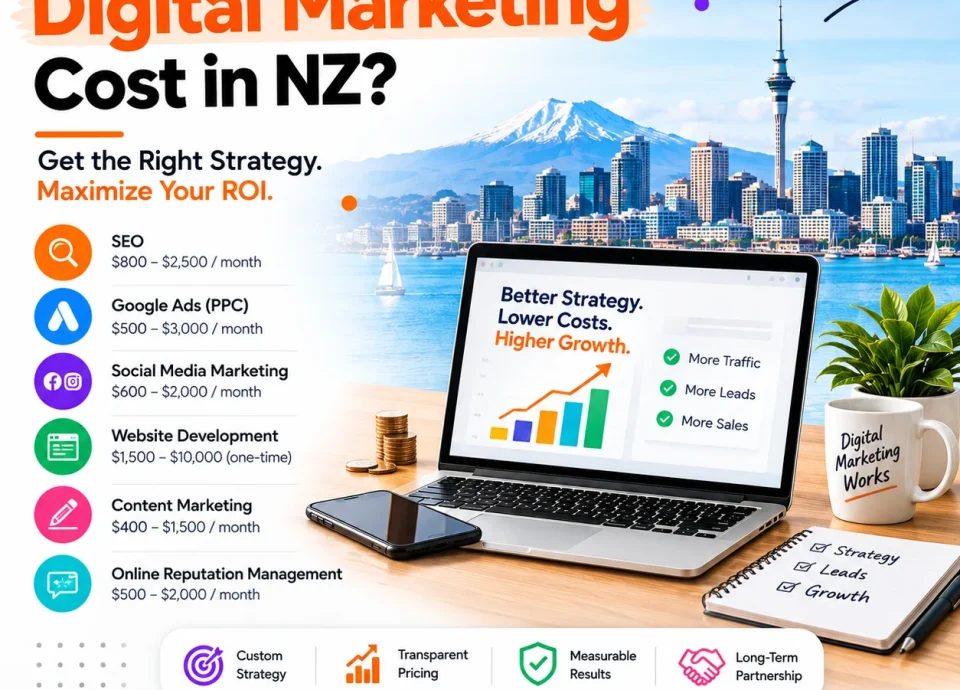
Costs vary widely depending on channel and competition, but many Auckland small businesses start with monthly budgets in the $1,000 to $3,000 range across SEO and Google Ads combined, scaling up as ROI becomes clearer.
How long does digital marketing take to show results?
Paid channels like Google Ads and social ads can generate leads within days. SEO and content marketing typically take three to six months to show meaningful movement, but the results tend to compound rather than disappear once spending stops.
Do I need an agency, or can I do digital marketing myself?
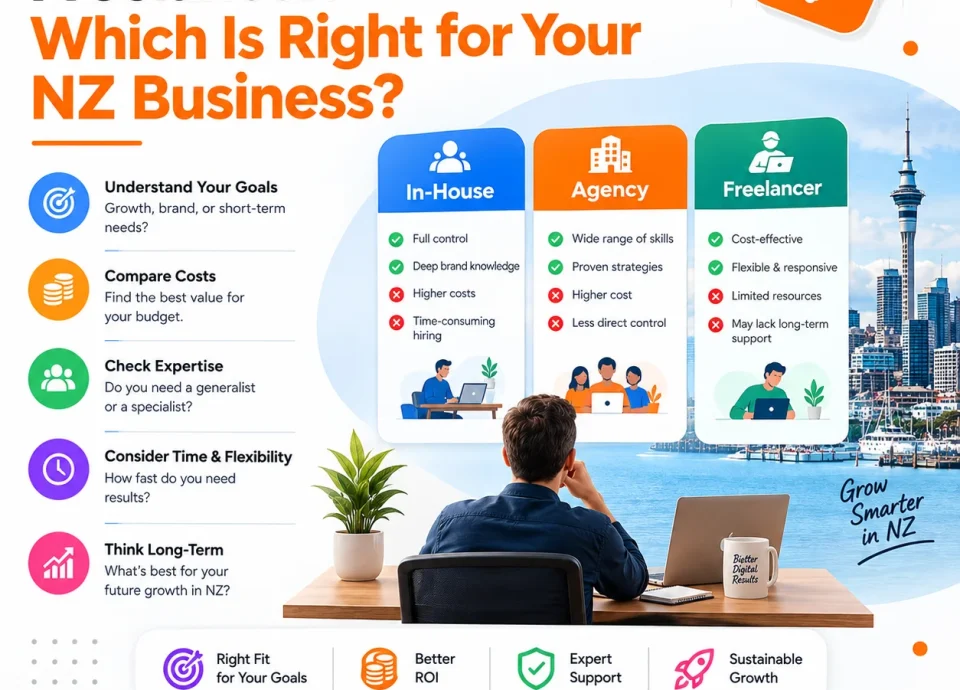
Small businesses with time and a willingness to learn can manage basic social media and email marketing themselves. SEO and Google Ads have a steeper learning curve, and mistakes there can waste budget quickly, which is why many businesses bring in a consultant or agency once they’re ready to scale.
Where to Start
If you’re weighing up SEO against Google Ads against social media, the honest answer is that the right starting point depends on how your customers actually search for you and how quickly you need results. A tradesperson chasing local jobs usually gets faster traction from Google Ads and Local SEO combined. A retail brand with a strong visual product often does better starting with social media and paid social ads. Whatever the mix, the same principle holds: pick channels deliberately, track what they’re actually doing, and build from there rather than trying to be everywhere at once.
At Kiwi SEO Agency, this is usually the first conversation we have with a new client, working out which one or two channels actually fit their business before spending a dollar on any of them.
1 Comment