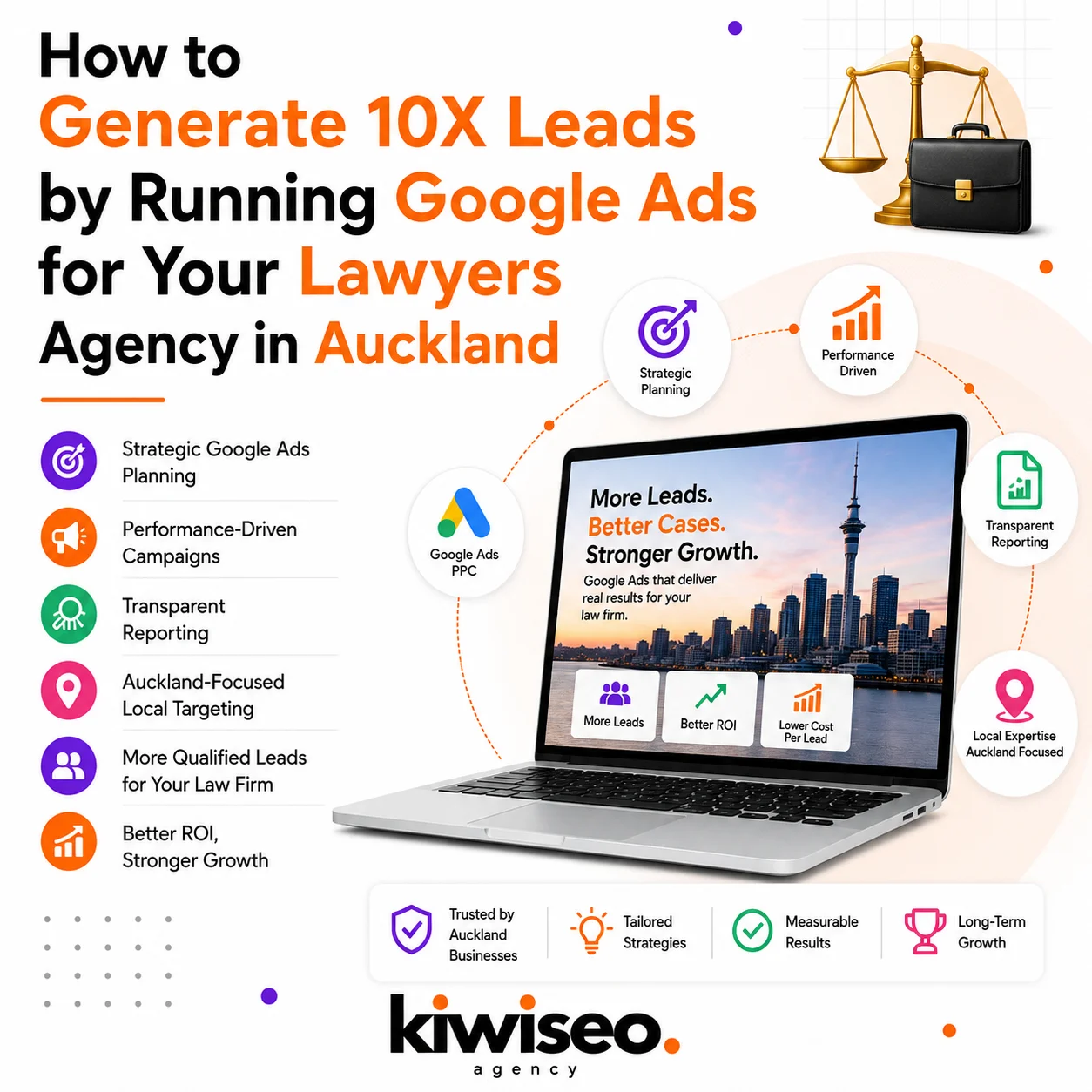
Turn Google Searches into Clients with Google Ads for Lawyers in Auckland
When people need legal help, they often turn to Google before contacting a law firm. Whether they are dealing with a divorce, employment dispute, property transaction, immigration matter or business issue, they want to find a suitable lawyer quickly.
This makes Google Ads for lawyers in Auckland a valuable way for law firms to reach potential clients when they are actively searching for legal services.
However, successful legal PPC is about much more than paying for clicks. Competitive keywords can become expensive, and poorly targeted campaigns can generate traffic without producing enough qualified enquiries. A successful strategy needs the right keywords, relevant advertisements, dedicated landing pages, accurate location targeting and reliable conversion tracking.
The goal should not simply be to generate more website visitors. It should be to connect your law firm with relevant people who need the legal services you provide.
Google Ads can then become part of a complete client acquisition system:
Search → Ad → Landing Page → Enquiry → Consultation → Client
Here is how Auckland law firms can build a more effective Google Ads strategy.
Why Google Ads Is Important for Auckland Law Firms
Legal searches often have strong commercial intent.
Someone searching for “family lawyer Auckland” is not necessarily browsing for general information. They may already have a legal problem and be looking for professional assistance.
Other examples include:
- Family lawyer Auckland
- Divorce lawyer Auckland
- Employment lawyer Auckland
- Property lawyer Auckland
- Immigration lawyer Auckland
- Commercial lawyer Auckland
- Business lawyer Auckland
- Criminal lawyer Auckland
These searches can be valuable because they connect your firm with people who have already identified a need.
Google Ads Can Provide Immediate Search Visibility
SEO is an important long-term investment, but it can take time to establish organic visibility for competitive legal searches.
Google Ads offers another way to appear prominently when potential clients search for relevant services.
This can be particularly useful for:
- New law firms building online visibility
- Established firms promoting specific practice areas
- Firms entering new Auckland markets
- Lawyers launching new services
- Practices looking for additional lead sources
However, visibility alone does not create clients.
Your campaign needs to attract the right searches, communicate a relevant message and provide an easy path to contact your firm.
1. Start with a Clear Legal PPC Strategy
Before selecting keywords or writing advertisements, decide what you actually want Google Ads to accomplish.
Different law firms have different commercial priorities.
For example, a family law practice may want more enquiries about:
- Divorce
- Separation
- Relationship property
- Parenting arrangements
- Family disputes
A commercial law firm may instead focus on:
- Business contracts
- Commercial property
- Company matters
- Business disputes
- Employment issues
Your advertising strategy should reflect the services that your firm wants to grow.
Define Your Ideal Client
Consider:
- Which legal services generate the most valuable matters?
- Which services have available capacity?
- Which locations does your firm serve?
- Which types of clients are the best fit?
- What action should a potential client take?
- What is a reasonable cost to acquire a new client?
These answers influence your keywords, campaigns, advertisements, landing pages and budget.
2. Conduct Keyword Research for Lawyer PPC
Keyword research is one of the foundations of an effective Google Ads campaign for lawyers.
The objective is not to collect hundreds of keywords simply because they have search volume.
Instead, identify searches that indicate genuine interest in your legal services.
Understand Search Intent
Legal searches can broadly be divided into three categories.
Informational Intent
These searches are primarily looking for information:
- What does a family lawyer do?
- How does divorce work in New Zealand?
- What is a personal grievance?
- How does conveyancing work?
These queries may be excellent opportunities for SEO content, but they do not always indicate that someone is ready to contact a lawyer.
Commercial Investigation
These users are comparing potential providers:
- Best family lawyers Auckland
- Family law firms Auckland
- Affordable employment lawyers Auckland
- Property lawyers Auckland
They may be closer to making a decision.
Transactional Intent
These searches demonstrate a stronger desire to take action:
- Hire a family lawyer Auckland
- Employment lawyer Auckland
- Property lawyer near me
- Immigration lawyer Auckland
These can be particularly valuable for search advertising.
3. Use Long-Tail Keywords to Find More Specific Leads
Broad keywords such as “lawyer Auckland” can attract a wide range of searches.
More specific keywords often provide clearer information about what the searcher needs.
For example:
Broad:
“lawyer Auckland”More specific:
“employment lawyer Auckland”Highly specific:
“employment lawyer Auckland personal grievance”Long-tail searches may have lower search volume, but they can provide valuable insight into the user’s legal problem and intent.
Your campaign should therefore balance:
- Core service keywords
- Location-based keywords
- Practice-area keywords
- Long-tail searches
- High-intent commercial terms
4. Use Negative Keywords to Reduce Wasted Ad Spend
Negative keywords help prevent your ads from appearing for searches that are unlikely to produce suitable enquiries.
Depending on your services, potentially irrelevant searches may include:
- Lawyer jobs
- Lawyer salary
- Law degree
- Law courses
- University
- Legal templates
- Legal definitions
- Free documents
However, negative keyword decisions should be based on your actual business model.
For example, a law firm that genuinely offers a free initial consultation should not automatically exclude every search containing “free consultation.”
The purpose of negative keywords is to remove irrelevant traffic without accidentally blocking valuable potential clients.
Regularly reviewing search-term data can reveal new irrelevant searches that should be excluded.
5. Structure Google Ads Campaigns Around Practice Areas
Avoid putting every legal service into one generic campaign.
A person searching for a divorce lawyer has a different need from someone searching for a commercial property lawyer.
Separate campaigns or tightly organised ad groups can make your advertising more relevant.
For example:
Family Law
- Family lawyer Auckland
- Divorce lawyer Auckland
- Separation lawyer Auckland
- Relationship property lawyer
Employment Law
- Employment lawyer Auckland
- Employment dispute lawyer
- Employment agreement lawyer
- Personal grievance lawyer
Property Law
- Property lawyer Auckland
- Conveyancing lawyer Auckland
- Property solicitor Auckland
- Commercial property lawyer
Commercial Law
- Commercial lawyer Auckland
- Business lawyer Auckland
- Company lawyer Auckland
- Commercial contract lawyer
The exact structure should depend on search volume, budget, services and campaign performance.
6. Write Google Ads That Match the Search
Your advertisement should immediately reassure the searcher that they have found a potentially relevant legal provider.
If someone searches for:
Employment lawyer Auckland
and sees:
Full-Service Auckland Law Firm
the connection is weak.
A more relevant message could be:
Employment Lawyers Auckland
Practical Employment Law Advice
Discuss Your Employment Matter
The ad should clearly communicate the relevant service and provide an appropriate next step.
Avoid unsupported claims such as “the best lawyer” or guarantees of a particular legal outcome. Legal advertising should be accurate and consistent with applicable professional and advertising requirements.
7. Use Responsive Search Ads Effectively
Google Ads uses responsive search ads that combine multiple headlines and descriptions to create different ad combinations. Google recommends using responsive search ads and relevant ad assets to improve relevance and reach.
For a legal campaign, your assets can communicate different aspects of the service.
For example:
Headlines:
- Family Lawyers Auckland
- Experienced Family Law Team
- Discuss Your Legal Matter
- Auckland Legal Advice
- Family Law Consultation
Descriptions:
- Get professional guidance for family law matters. Contact our Auckland legal team to discuss your situation.
- Practical legal advice tailored to your circumstances. Speak with our team about your family law needs.
Test different messages rather than relying on one advertisement indefinitely.
Google also provides asset-level reporting that can help advertisers identify which headlines and descriptions are performing more effectively.
8. Send Google Ads Traffic to Relevant Landing Pages
One of the most common PPC mistakes is sending every visitor to the homepage.
A person searching for a specific legal service should ideally arrive on a page that directly addresses that service.
For example:
Search:
Divorce lawyer AucklandAd:
Divorce Lawyers AucklandLanding page:
Divorce and Family Law ServicesThis creates a consistent journey from search query to conversion.
A dedicated legal landing page should clearly explain:
- What the service involves
- Who the firm helps
- Common legal situations
- How the firm can assist
- What the next step is
- How the visitor can make contact
9. Build Landing Pages That Convert Visitors into Enquiries
A strong landing page needs more than keywords.
It should make the visitor feel confident that they have reached a relevant professional service.
Important elements include:
Clear Headline
Tell visitors exactly what service you provide.
Experienced Family Lawyers in Auckland
Relevant Supporting Content
Explain the firm’s approach and the types of matters it handles.
Clear Call to Action
Examples include:
- Request a consultation
- Call our legal team
- Contact us today
- Book an appointment
- Discuss your legal matter
Trust Signals
Where accurate and appropriate, consider including:
- Lawyer qualifications
- Professional memberships
- Relevant experience
- Client testimonials
- Reviews
- Practice areas
- Office information
Your claims should always be genuine and supportable.
10. Optimise for Mobile Users
Potential clients do not necessarily search for lawyers from a desktop computer.
Your website and landing pages should provide a smooth experience on smartphones and tablets.
Important considerations include:
- Fast loading times
- Responsive design
- Easy-to-read text
- Simple navigation
- Click-to-call functionality
- Visible contact details
- Short, straightforward enquiry forms
If someone urgently needs legal help, making them search around your website for a phone number creates unnecessary friction.
11. Target Auckland and the Right Service Areas
Location targeting can help Auckland law firms control where their ads appear.
Depending on the firm’s actual service area, campaigns may focus on:
- Auckland
- Central Auckland
- North Shore
- East Auckland
- South Auckland
- West Auckland
- Specific surrounding areas
The correct targeting depends on where your clients are located and whether your firm serves clients remotely throughout New Zealand.
Do not target a large geographic area simply to generate more impressions.
Instead, use campaign data to identify where qualified enquiries and clients actually come from.
12. Use Google Ads Assets to Increase Visibility
Google Ads provides different assets that can add useful information to your advertisements.
These may include:
- Sitelinks
- Call assets
- Location assets
- Structured snippets
- Business information
For example, sitelinks could direct users to:
- Family Law
- Employment Law
- Property Law
- Commercial Law
- About Us
- Contact
Call and location assets can also make it easier for potential clients to contact or locate a physical practice where appropriate. Google recommends using relevant assets because they can provide additional information and create more ways for people to interact with a business.
13. Track Calls, Forms and Consultation Requests
Clicks are not the final objective of a law firm’s Google Ads campaign.
A campaign should track meaningful actions such as:
- Phone calls
- Contact forms
- Consultation requests
- Appointment bookings
- Email enquiries
This allows you to understand which campaigns are generating actual opportunities.
For example, a keyword may produce hundreds of clicks but very few enquiries.
Another keyword may produce fewer visitors but significantly more consultation requests.
Without conversion tracking, it is difficult to identify that difference.
14. Measure Lead Quality, Not Just Lead Volume
Not every enquiry has the same value.
Suppose Campaign A generates 100 leads but only 10 are suitable for your firm.
Campaign B generates 50 leads but 25 are qualified.
Campaign B may be substantially more valuable.
For law firms, important performance measures can include:
- Click-through rate
- Cost per click
- Conversion rate
- Cost per lead
- Qualified leads
- Consultation bookings
- New clients
- Cost per acquired client
Ultimately, the most important question is not:
How many clicks did we get?
It is:
How many valuable new client opportunities did the campaign generate?
15. Optimise Your Google Ads Campaign Continuously
Google Ads is not a “set it and forget it” marketing channel.
Search behaviour, competition, costs and campaign performance change over time.
Regular optimisation can include:
- Reviewing search terms
- Adding negative keywords
- Testing ad messaging
- Improving landing pages
- Adjusting geographic targeting
- Reviewing conversion data
- Allocating budget to stronger campaigns
- Identifying underperforming keywords
Google also provides search-term insights for responsive search ads, grouping search activity into intent-based categories that can help advertisers understand how people are finding their ads.
This data can uncover opportunities that were not obvious during the original keyword research.
16. Avoid These Common Legal PPC Mistakes
Using Only Broad Keywords
Broad targeting can attract irrelevant searches and consume budget.
Sending All Traffic to the Homepage
A generic homepage may not satisfy the intent behind a specific legal search.
Ignoring Phone Calls
For many law firms, phone enquiries are an important part of lead generation.
Measuring Only CTR
A high click-through rate does not necessarily mean the campaign is producing clients.
Using the Same Ad for Every Service
Family law, employment law and commercial law require different messaging.
Ignoring Negative Keywords
Irrelevant searches can continue consuming budget if search terms are not reviewed.
Making Unsubstantiated Claims
Avoid guarantees or exaggerated statements that could mislead potential clients.
17. Combine Google Ads with SEO and Local Search
Google Ads should not necessarily operate separately from your wider digital marketing strategy.
A strong law firm marketing strategy can combine:
- Google Ads
- SEO
- Local SEO
- Google Business Profile optimisation
- Legal content marketing
- Service pages
- Client reviews
- Conversion optimisation
For example, a family law firm could use Google Ads to target:
Family lawyer Auckland
At the same time, its SEO strategy could target informational searches such as:
How does separation work in New Zealand?
How is relationship property divided?
This allows the firm to reach potential clients at different stages of the decision-making process.
18. Calculate the Real ROI of Lawyer PPC
The success of a Google Ads campaign should ultimately be evaluated against business outcomes.
A simple model is:
Ad Spend → Leads → Qualified Leads → Clients → Revenue
For example, imagine a campaign spends $4,000 and generates 50 enquiries.
That gives:
Cost per lead = $80
If eight of those enquiries become clients:
Cost per acquired client = $500
Whether that is profitable depends on the value of the resulting legal matters.
This is why law firms should consider client acquisition economics rather than judging PPC purely by traffic metrics.
19. Why Professional Google Ads Management Can Make a Difference
Managing PPC for a law firm requires ongoing attention to keyword targeting, campaign structure, advertisements, landing pages and conversion data.
Professional Google Ads management can include:
- PPC account audits
- Keyword research
- Campaign setup
- Ad creation
- Negative keyword management
- Location targeting
- Conversion tracking
- Landing page recommendations
- Search-term analysis
- Performance reporting
- Ongoing optimisation
The objective is to create a system that learns from performance rather than simply spending the monthly advertising budget.
Conclusion: Build a Google Ads Strategy Focused on Clients, Not Just Clicks
Google Ads for lawyers in Auckland can provide a powerful way to reach potential clients who are actively searching for legal services.
But successful legal PPC requires more than bidding on keywords.
The strongest campaigns combine:
- High-intent keyword research
- Practice-area segmentation
- Relevant search advertisements
- Auckland-focused targeting
- Negative keyword management
- Dedicated landing pages
- Mobile optimisation
- Conversion tracking
- Lead-quality analysis
- Continuous campaign optimisation
The real objective is not simply to appear at the top of Google or generate more clicks.
It is to put your law firm in front of the right potential clients, provide a relevant experience and make it easy for them to take the next step.
If your Auckland law firm wants to generate more qualified enquiries through paid search, Kiwi SEO Agency’s Google Ads service can help you develop a PPC strategy focused on relevant traffic, conversions and measurable business outcomes.
Ready to turn more Google searches into legal enquiries? Contact Kiwi SEO Agency to discuss your Google Ads strategy.
Frequently Asked Questions
Is Google Ads effective for lawyers in Auckland?
Google Ads can be an effective lead-generation channel for law firms because it allows them to reach people actively searching for specific legal services. Results depend on factors including competition, keywords, advertisements, landing pages, targeting and conversion tracking.
How much should a law firm spend on Google Ads?
There is no universal budget. Costs depend on the practice area, competition, search demand, geographic targeting and the value of new clients. The right budget should be based on what the firm can sustainably spend to acquire qualified clients.
What are the best Google Ads keywords for lawyers?
The best keywords depend on the firm’s services. Examples include “family lawyer Auckland,” “employment lawyer Auckland,” “property lawyer Auckland” and other specific practice-area searches with clear commercial intent.
Should law firms use separate landing pages?
Yes, dedicated landing pages can create a stronger connection between the search query, advertisement and service. A visitor searching for employment law should ideally land on an employment law page rather than a generic homepage.
How can a law firm reduce wasted Google Ads spend?
Use relevant keyword targeting, monitor search terms, add appropriate negative keywords, target relevant geographic areas and regularly evaluate which campaigns and keywords produce qualified enquiries.