
Most Auckland business owners can tell you their website traffic feels off. Enquiries have dropped. A competitor keeps showing up above them for terms they used to own. Rankings that took months to build seem to be sliding for no obvious reason. Feelings are a reasonable starting point, but they are a poor basis for deciding where to spend a marketing budget.
An SEO audit turns that feeling into a diagnosis. It is a structured review of a website and its organic search performance that identifies exactly what is holding a site back, whether the cause is technical, content related, competitive, or structural, and sets out a clear, prioritized path to fix it.
What an SEO audit actually is
An SEO audit examines how easily search engines can crawl and understand a website, how well its content matches what people are actually searching for, how the site’s authority compares to competitors already ranking above it, and how effectively organic visitors turn into enquiries or sales.
The output should never be a bare score out of 100. A useful audit hands the business owner a prioritized list of specific issues, each one explained in terms of its impact and the effort needed to fix it. If an audit does not say what to do first and why, it has not done its job.
For businesses in Auckland’s crowded market, this diagnostic step matters even more. Competing for customers in the region often means competing against dozens of other local businesses for the same handful of search terms, and small technical or content gaps can be the difference between page one and page three.
What a proper SEO audit covers
Technical SEO
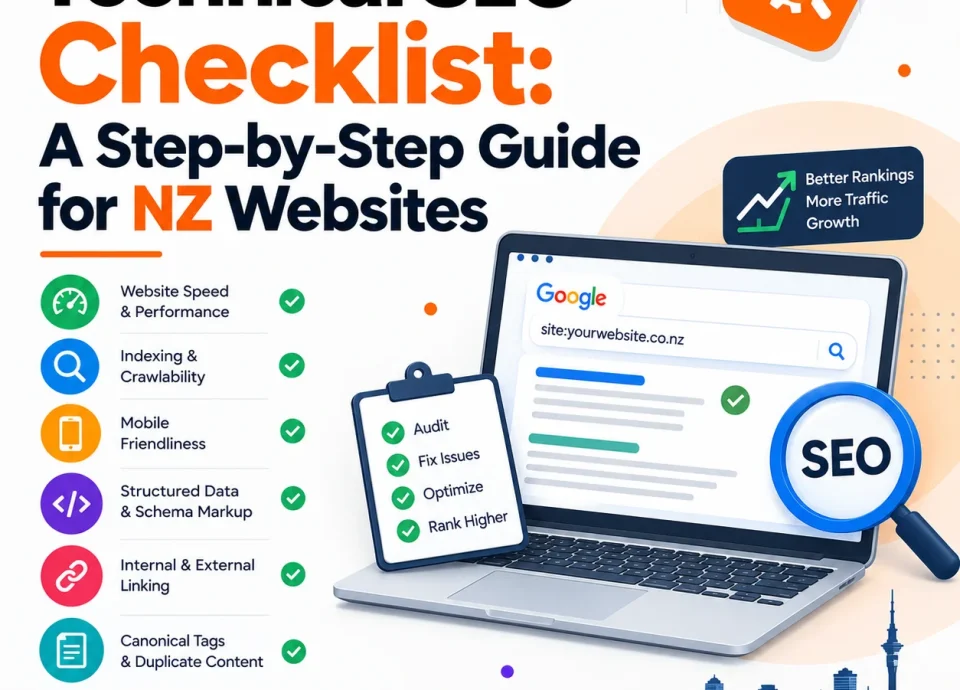
This is the foundation everything else sits on. Can Google crawl, render, and index the site efficiently? A technical review checks crawlability and indexation, site speed and Core Web Vitals, mobile usability, site architecture and internal linking, structured data, and problems like duplicate content, broken pages, and redirect chains. A site can look perfectly fine to a human visitor and still be quietly invisible to search engines underneath.
On page content and keyword targeting
This part of the audit asks a simple question: does each page deserve to rank? It looks at whether pages target a clear search intent, how original and useful the content actually is, heading structure, title tags, and meta descriptions. Auckland businesses often have pages built around generic industry language rather than the specific phrases local customers type into Google, and closing that gap is frequently the fastest win in the whole process.
Local SEO and Google Business Profile
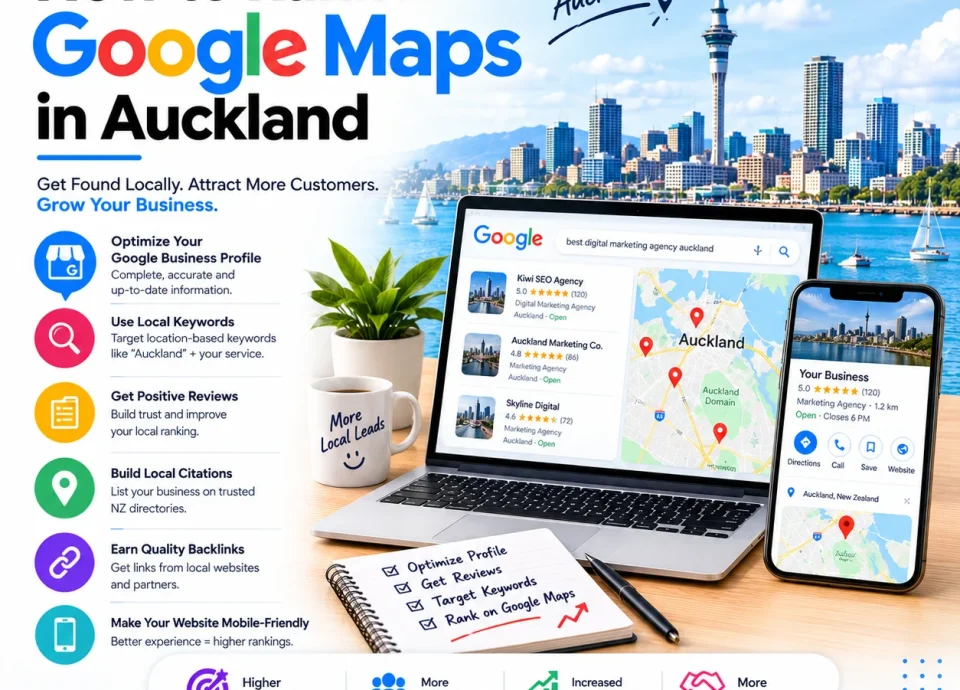
For an Auckland business chasing nearby customers, local signals carry real weight: Google Business Profile optimization, consistent name, address, and phone details across directories, and performance for map pack and “near me” searches.
Competitor and keyword gap analysis
An audit should map where a site currently ranks, where genuine opportunities sit, and who actually occupies the positions the business wants. The most valuable findings tend to be striking distance keywords: terms already ranking on page two where a small push, not a rebuild, gets the page onto page one.
Authority and backlinks
Links from credible, relevant websites remain a meaningful trust signal. This part of the audit reviews the backlink profile against competitors that are outranking the site, flags anything toxic or spammy, and points to realistic opportunities to close the authority gap.
User experience and conversion
Ranking is only half the job. A complete audit also looks at what happens after the click: page experience, engagement, and whether key landing pages are actually structured to turn a visitor into a customer. There is little value in doubling organic traffic to a page that converts nobody.
Why this matters more in 2026 than it used to
Two shifts have raised the stakes for Auckland businesses this year. Google’s algorithm update cadence has sped up, and issues once tolerated for years now get punished quickly. At the same time, AI powered search features have broken the old link between rankings and clicks. A page can hold its position in Search Console while an AI Overview quietly absorbs the click that used to land on the website.
An audit is how a business tells these causes apart. A traffic decline caused by a technical fault, a content quality problem, or a shift in search behaviour each demands a different fix, and businesses regularly spend months solving the wrong one because nobody diagnosed the actual cause first.
How the audit process actually works
A proper audit follows a sequence, not a checklist run in random order. It starts with crawling the site the way Google does, using tools that map every indexed page, every redirect, and every broken link, so the technical picture is based on evidence rather than a quick manual click through. From there, the auditor cross references Search Console and Analytics data against the crawl, looking for pages that get impressions but no clicks, or clicks but no conversions. That gap between traffic and outcome usually points straight at the problem.
Next comes the competitive layer. The auditor pulls the pages currently outranking the business for its target terms and compares them directly: content depth, backlink count, page speed, structured data. This is where striking distance opportunities surface, since a page sitting at position 11 or 12 often needs a specific, identifiable fix rather than a rebuild.
The findings then get weighted by effort against impact, not just severity. A broken redirect chain might be urgent but quick to fix, while a content gap against three competitors takes longer but moves more traffic. Auckland businesses working with a limited budget benefit most from this weighting, since it turns a long list of issues into a sequence they can actually act on.
How to choose the right SEO audit provider in Auckland
Not every audit delivers the same value, and the gap between a genuinely useful one and a wasted afternoon usually comes down to who’s doing the work. An automated tool can generate a 40-page PDF in minutes, but it can’t tell a business which ten issues actually matter this quarter versus which fifty are cosmetic noise. That judgment call needs a person who has looked at hundreds of Auckland websites and knows what separates a real ranking blocker from a theoretical one.
A few questions are worth asking before committing to a provider. Does the audit involve a manual review, or is it purely software generated? Will the findings be prioritised by impact and effort, or handed over as an undifferentiated list? Does the auditor understand the specific competitive landscape for the business’s industry in Auckland, rather than applying a generic template across every client? And critically, does the audit come with a clear next step, or does it simply describe problems without a path forward?
Price is a reasonable filter but not the only one. A free audit can be a useful starting point for spotting obvious issues, while a paid, senior led audit tends to dig into the striking distance opportunities and competitive gaps that automated reports miss entirely.
Signs an Auckland business needs an SEO audit
A business does not need an audit every month, but certain situations make one genuinely worthwhile:
- Organic traffic has flattened or declined and the reason isn’t obvious
- The site has never been audited, despite ongoing investment in content or paid ads
- The website was recently rebuilt or migrated to a new platform
- A competitor has overtaken rankings for terms the business used to own
- Enquiries have dropped even though traffic looks steady
- The business is about to commit budget to SEO and wants to know the starting position first
That last point is worth sitting with. Committing to ongoing SEO work without an audit first is a bit like renovating a house without a builder’s report. Sometimes everything underneath is fine. The point is knowing before spending, not after.
What happens after the audit
The audit itself doesn’t move a single ranking. Its value is entirely in what happens next, which is why the real deliverable is a prioritised roadmap: quick technical fixes and striking distance content wins first, followed by the medium term content and authority work that compounds over months.
This is also where a lot of businesses stall. An audit report sitting unread in an inbox delivers zero return regardless of how thorough it was. The roadmap needs an owner, whether that’s an in-house marketing person or the agency that ran the audit, and a realistic timeline attached to each fix so progress can actually be tracked against it.
The Auckland businesses that get the most out of an audit treat it as the opening step of a broader plan, with clear tracking through Google Analytics and Search Console so the impact of each fix stays visible rather than anecdotal. Revisiting the same metrics monthly, rather than waiting for the next annual audit, is usually what separates businesses that compound their gains from those that plateau again within a year.
How Kiwi SEO Agency approaches an audit
At Kiwi SEO Agency, an SEO audit is the starting point for every engagement, not an upsell tacked on afterward. The process covers local SEO and Google Business Profile optimisation, on page content and metadata, technical health, and off page authority, benchmarked against the Auckland competitors already outranking the business. Every audit ends with a prioritised, plain English plan rather than a jargon heavy PDF nobody reads.
FAQs
What does an SEO audit involve?
An SEO audit involves a structured review of technical health, on page content, local SEO signals, keyword rankings, and backlink authority, delivered as a prioritised list of issues and fixes rather than a raw score.
How long does an SEO audit take?
Most SEO audits take between one and four weeks, depending on the size of the website and how thorough the review needs to be. A small local business site moves faster than a large ecommerce catalogue.
How much does an SEO audit cost in Auckland?
Costs vary by scope and depth, with some agencies offering a free introductory audit and others charging for a senior led, in depth review. Kiwi SEO Agency includes an initial audit as part of its SEO packages rather than pricing it separately.
Is a free SEO audit worth doing?
A free SEO audit is worth doing as a starting point, though it typically relies on automated tools rather than a manual review. It’s useful for spotting obvious issues, but a deeper paid audit usually finds the striking distance opportunities an automated report misses.
How often should a business get an SEO audit?
Most businesses benefit from a full audit once a year, plus a fresh one after any major website rebuild, migration, or noticeable drop in traffic or enquiries.