Most Kiwi businesses don’t have a social media marketing strategy. They have a posting habit. Someone uploads a photo when the shop’s quiet, shares a review when a customer’s happy, and calls it marketing. That’s not a strategy, it’s a hobby with a business logo attached.
A real social media marketing strategy is a written plan that sets goals, picks the right platforms, defines what you’ll post and why, and tells you whether any of it worked. Without one, you’re guessing every week. With one, every post has a job to do.
This guide walks through building a social media marketing strategy for 2026, built around what’s actually working for New Zealand businesses right now, not generic advice lifted from a US playbook. It’s written as a step-by-step process you can work through in order, whether you’re starting from nothing or trying to fix a strategy that’s stalled.
Small business owners across Australia, Canada, New Zealand, the UK, and the US now rank social media posting and paid ads as the channel most likely to drive growth in 2026, ahead of every other marketing option available to them. That’s a strong signal, but only if the effort behind it is organised rather than reactive.
Why New Zealand Businesses Need a Different Approach
Social media in New Zealand doesn’t behave like social media in bigger markets. Facebook still holds roughly 76% of the social media market share here, reaching close to 4.68 million active users out of a population of about 5.24 million. That’s not a platform to skip just because it feels less exciting than TikTok.
Kiwi audiences also respond differently to tone. Content that reads as polished, corporate, or copy-pasted from an overseas brand tends to fall flat. New Zealanders are quick to spot the hard sell, and they trust businesses that show the real people behind the logo, local references, and a bit of self-deprecating humour over anyone chasing viral formulas.
A few numbers worth keeping in mind while you plan:
- 45.8% of ANZ businesses lean on organic social media as their main way to find new customers, with 29.5% using paid social ads
- Owners rate social channels as critical for reputation and credibility (93.3%) and customer engagement (91.6%)
- 73% of NZ marketers expect short-form video to dominate content strategy through 2026
- 27.7% of Kiwis follow influencers, and micro-influencer partnerships are delivering three to five times higher engagement than average posts
None of this means throw out your existing plan and chase every platform at once. It means build the strategy around how New Zealanders actually use social media, not how a global case study says they should.
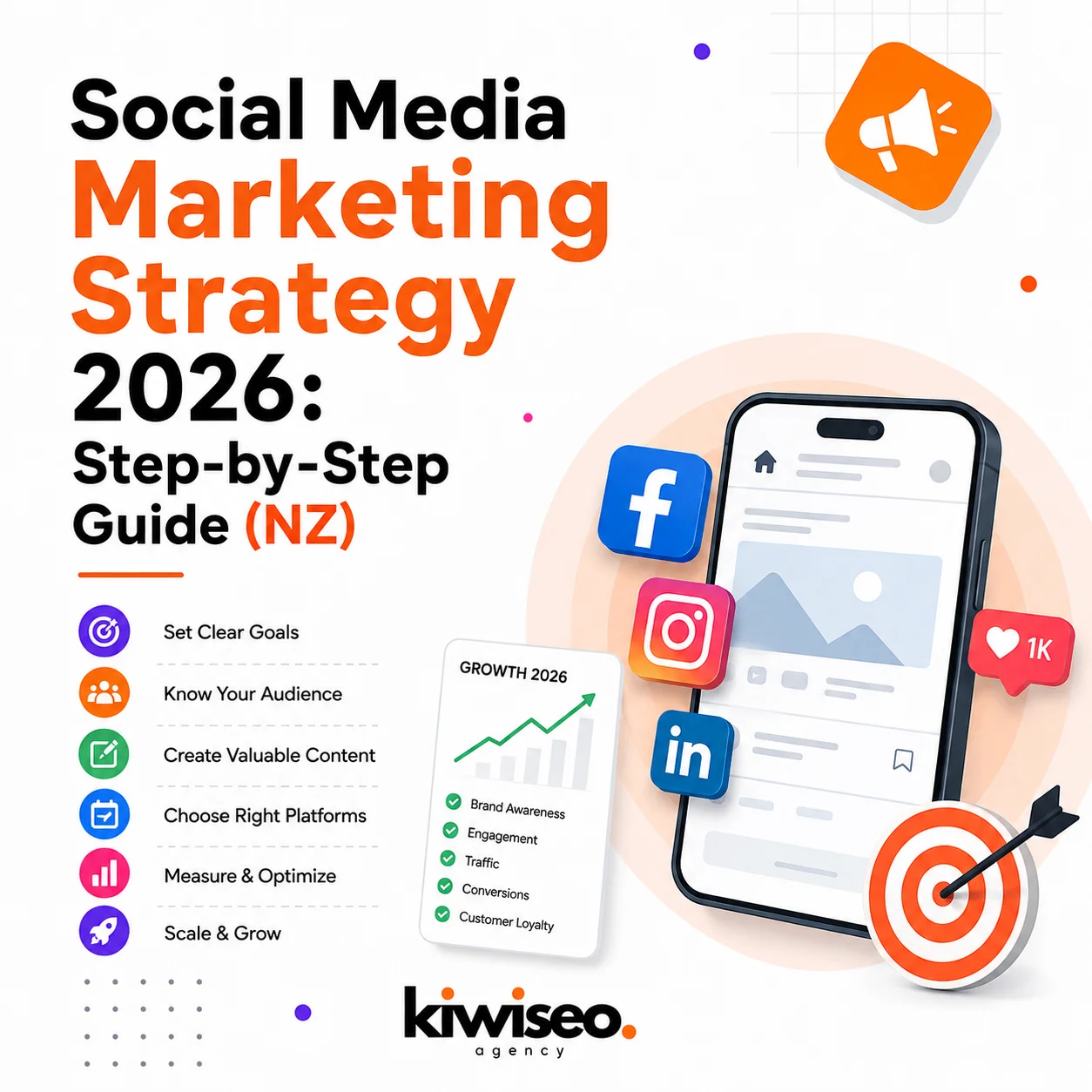
Step 1: Set Goals That Aren’t Just “Get More Followers”
Every strong social media marketing strategy starts with a goal that connects to the business, not the platform. Follower count feels good to watch, but it doesn’t pay the bills. Pick two or three goals instead, and make each one specific enough to measure. Common options for NZ small businesses include:
- Generating a set number of qualified leads or enquiries per month
- Driving foot traffic or bookings for a local trades or hospitality business
- Growing email sign-ups so you’re not entirely dependent on an algorithm
- Building brand awareness ahead of a product or service launch
Write the goal down with a number and a timeframe attached. “Grow engagement” isn’t a goal. “Generate 25 enquiry-form submissions a month from Instagram by December” is.
Step 2: Audit What You’re Already Doing
Before adding anything new, look at what already exists. Pull up your last three months of posts across every platform and note what got engagement, what got ignored, and what actually converted into a sale or booking. Most businesses find that ten percent of their content did eighty percent of the work.
The audit should also cover your competitors. What are other local businesses in your space posting, and where are the gaps? If three competitors are all doing the same generic product shots, a behind-the-scenes series or a customer story format is an easy way to stand out.
Step 3: Know Exactly Who You’re Talking To
A social media marketing strategy without a defined audience ends up speaking to everyone and connecting with no one. Build a simple profile: who’s the customer, what problem are they trying to solve, and which platform do they actually spend time on.
Age, location, and buying stage all matter here. A Auckland-based trades business chasing homeowners over 40 probably gets more value from Facebook than TikTok. A youth fashion brand selling nationally is likely the reverse. Don’t assume, check your existing analytics for where your current audience already sits.
Step 4: Choose Fewer Platforms, Not More
This is the step most businesses get wrong. Trying to run five platforms well with no dedicated marketing team usually means running five platforms badly. Pick one or two platforms where your audience actually spends time and commit properly, rather than posting thin content everywhere.
A quick reference for the NZ market in 2026:
- Facebook – still the largest reach in New Zealand, strong for local services, trades, and community-driven brands
- Instagram – best for visual brands, hospitality, retail, and businesses wanting Reels and carousel-style content
- LinkedIn – the go-to for B2B lead generation and professional services
- TikTok – growing fast for short-form video, especially with younger audiences
Resist the pressure to be everywhere at once. A business that shows up consistently on one platform its customers actually use will outperform a business spread thin across four platforms updated once a fortnight. Once the first platform is running well and delivering measurable results, that’s the right time to test a second, not before.
Step 5: Build Content Pillars Instead of Random Posts
Content pillars are three to five recurring themes that every post ties back to. They stop you from staring at a blank content calendar every Monday, and they make your feed feel coherent instead of scattered. A café might use “Our Coffee,” “Behind the Scenes,” and “Community Stories” as pillars. A professional services firm might run “Client Wins,” “Industry Tips,” and “Team Culture.”
Once you have pillars, content creation gets a lot faster because you’re filling a category, not inventing a topic from scratch each time.
Step 6: Plan a Content Calendar You Can Actually Stick To
Consistency beats frequency. Posting three times a week reliably outperforms posting daily for two weeks and then going quiet for a month. Map out a 30-day content calendar first, using your pillars to guide the mix, then extend it once the rhythm feels manageable.
Build in a mix of formats: short-form video, carousels or document-style posts that teach something step by step, and simple text or photo updates for quick wins. Short-form video in particular is worth prioritising given how strongly it’s trending across NZ audiences right now.
Step 7: Layer in Paid Social Where It Makes Sense
Organic content builds trust, but paid social is where reach and targeting get serious. Meta remains the strongest paid platform for most NZ consumer businesses, with global benchmarks pointing to an average return on ad spend around 4.2x. A reasonable starting budget for a small business sits around NZ$1,500 to $2,500 a month, enough to test audiences and creative without guessing blind.
Retargeting campaigns, in particular, tend to perform well for NZ businesses because they’re re-engaging people who already know the brand, rather than trying to win over a cold audience from scratch.
Step 8: Engage, Don’t Just Broadcast
Posting and disappearing is one of the fastest ways to underperform on social media. Replying to comments and messages consistently is one of the strongest engagement patterns available, and it costs nothing but time. Set aside a fixed block each day to respond to comments, DMs, and mentions rather than letting them pile up.
Community engagement also matters more in New Zealand’s smaller, closer-knit market than it might elsewhere. A personal reply from a business owner carries real weight when the audience is local and word travels fast.
Step 9: Track the Metrics That Actually Matter
Vanity metrics like likes feel nice, but they don’t tell you whether the strategy is working. Tie your reporting back to the goals from Step 1. If the goal was enquiries, track enquiries. If it was bookings, track bookings. Weekly or monthly reporting should cover reach, engagement rate, click-throughs, and conversions, not just follower growth.
Public engagement numbers are also becoming a less reliable signal on their own. A growing share of social activity in New Zealand is shifting into private messages and passive scrolling rather than public likes and comments, so don’t judge a campaign’s success purely on what’s visible on the post itself.
Step 10: Review, Adjust, and Repeat
A social media marketing strategy isn’t a document you write once and file away. Revisit it every month against your KPIs, and every quarter against your bigger business goals. If a platform, format, or pillar isn’t pulling its weight after a fair trial, cut it and reinvest that time elsewhere. The businesses that win on social media in 2026 aren’t the flashiest, they’re the ones treating it as an ongoing process rather than a one-off project.
Frequently Asked Questions
What is a social media marketing strategy?
A social media marketing strategy is a documented plan that sets out which platforms a business will use, who it’s trying to reach, what content it will post, and how it will measure results. It answers four questions: where, who, what, and how you’ll know it’s working.
How often should a small NZ business post on social media?
Posting frequency depends on the platform and the resources available, but three consistent posts a week on one or two platforms beats daily posting on five. Consistency and engagement matter more than raw volume, especially for smaller teams without a dedicated social media manager.
Is Facebook or Instagram better for New Zealand businesses?
It depends on the audience, though Facebook currently holds the largest overall reach in New Zealand at around 76% of the social media market. Instagram tends to suit visually driven brands like hospitality and retail, while Facebook works well for local services and community-focused businesses.
How much should a small business spend on paid social ads?
A reasonable starting point for NZ small businesses is NZ$1,500 to $2,500 a month on Meta platforms, which is enough to test audiences and ad creative properly. Budgets can scale up once a campaign shows a positive return.
How do I know if my social media strategy is working?
Track it against the specific goals set at the start, such as enquiries, bookings, or email sign-ups, not just likes or follower growth. Reviewing performance monthly against KPIs and quarterly against broader business goals keeps the strategy honest.
Should I hire a social media marketing agency or do it myself?
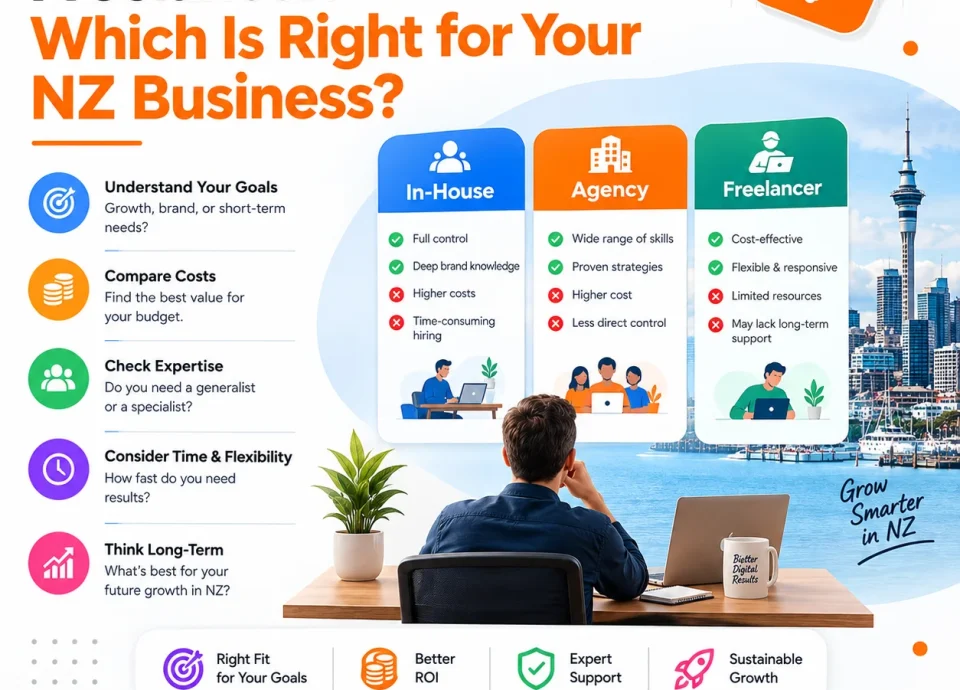
It depends on time, budget, and in-house skill. Many NZ businesses start out managing social media themselves and bring in a specialist agency once they need consistent content, paid ad management, and reporting across multiple platforms without stretching internal resources too thin.
Building the Strategy Is the Hard Part, Running It Is Harder
Writing a social media marketing strategy is one afternoon’s work. Executing it week after week, across content creation, community management, paid ads, and reporting, is where most businesses run out of time. If you’d rather have a team handle the strategy and the execution, Kiwi SEO Agency’s social media marketing strategy in Auckland cover strategy, content, paid advertising, and performance reporting under one roof for businesses across New Zealand.