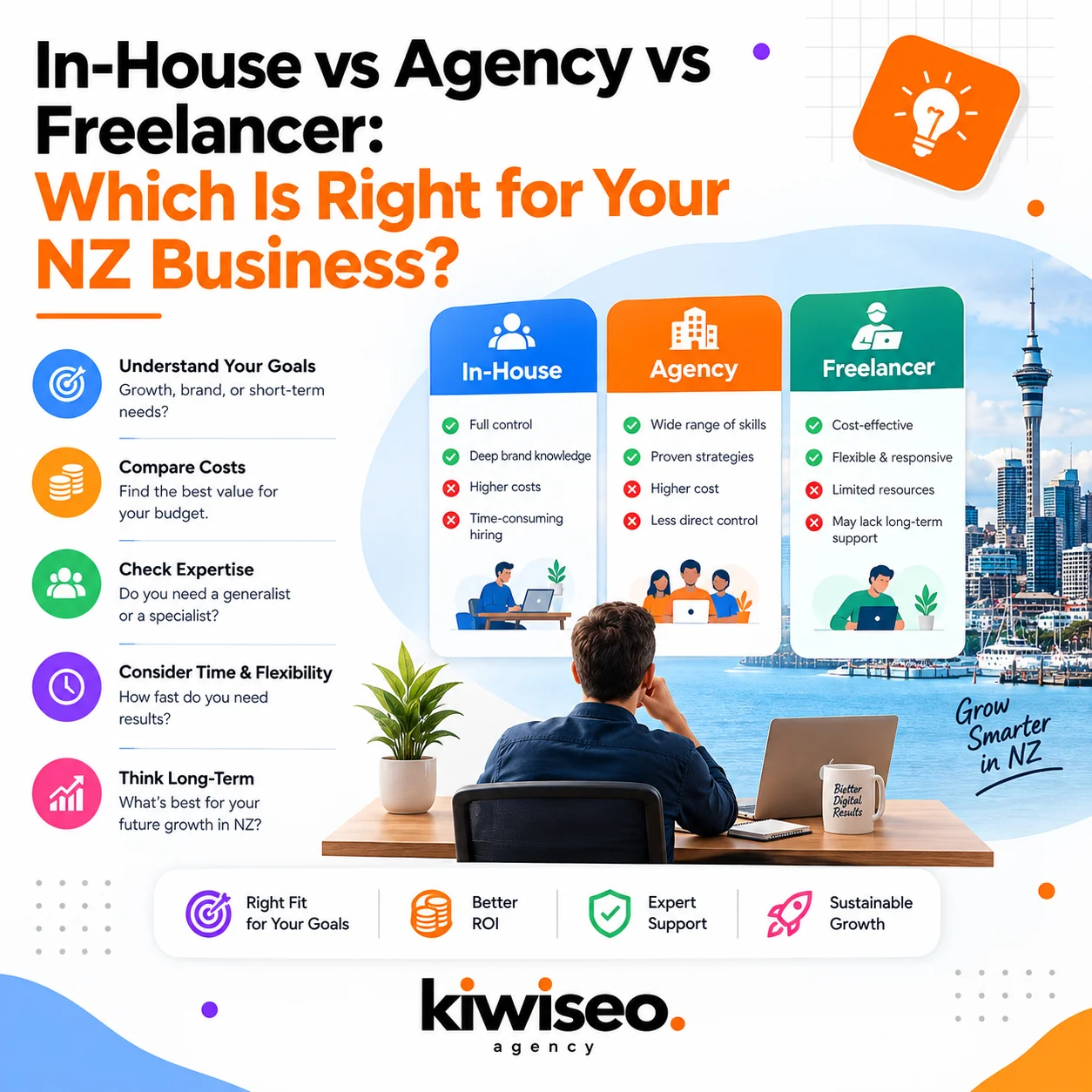
At some point, every growing New Zealand business hits the same question: who should actually run the digital marketing? The options split three ways — build an in-house team, partner with an agency, or bring in a freelancer for specific work. Each path has a genuinely different cost structure, level of control, and ceiling on expertise, and the right answer depends less on preference and more on where the business actually sits in terms of size, budget, and complexity.
There’s no universally correct choice here. A five-person Auckland retailer and a fifty-person Wellington SaaS company need different marketing structures entirely, and businesses that pick based on what worked for a friend’s company, rather than their own numbers, tend to overpay or under-deliver within a year.
In-house marketing: what it actually costs
Hiring in-house means bringing a marketer, or a small team, onto payroll. The appeal is obvious: someone who sits in on strategy meetings, knows the product inside out, and is available whenever something urgent comes up. Institutional knowledge compounds over time in a way that’s hard to replicate with an outside partner.
The real cost, though, goes well beyond salary. A New Zealand business hiring a marketing manager is also covering KiwiSaver contributions, a laptop and software subscriptions, office overhead, and the weeks it takes to onboard and train someone new. If that person leaves, the recruitment cycle starts over, often taking months and leaving a capability gap in the meantime.
There’s also a coverage problem. A single in-house marketer, however capable, cannot be simultaneously excellent at SEO, paid ads, content, email, and design. Most small in-house hires end up as generalists stretched across five disciplines, doing each one at a fraction of the depth a specialist would bring. That’s rarely a reflection of the person’s skill; it’s simply what happens when one role is asked to cover a whole department’s worth of work.
In-house tends to make the most financial and strategic sense once a business has the budget to build a real team, not just one generalist, and once marketing has become central enough to the business that daily involvement and institutional knowledge genuinely outweigh the cost of building that capability internally.
Agencies: buying a team, not a person
An agency swaps a single hire for access to a full team of specialists, typically for a monthly retainer that’s comparable to, or sometimes lower than, one full-time salary. Instead of one generalist, the business gets an SEO specialist, a paid ads manager, a content writer, and a strategist, each already experienced and already up to date with current algorithm and platform changes.
This is the main argument for agencies: depth without the overhead. There’s no sick leave or annual leave to plan around, no recruitment cost if someone moves on, and no ramp-up period, since the agency already has established processes. Agencies also see patterns across dozens of clients and industries, which tends to surface strategic ideas a single in-house hire, working only within one company’s data, would never encounter. A full-service agency typically brings specialist coverage across SEO, Google Ads, and social media marketing under one roof, rather than one generalist trying to cover all three.
The trade-off is control and brand intimacy. An agency doesn’t sit in the office, doesn’t absorb company culture by osmosis, and needs deliberate onboarding to understand a brand’s voice and positioning properly. For businesses in specific regions, choosing a locally based New Zealand agency over an offshore one closes part of that gap, since a Kiwi agency already understands local search behaviour, competitor sets, and how New Zealand customers actually respond to messaging, in a way generic international agencies rarely do.
Agencies suit businesses that have outgrown DIY marketing or a single generalist hire, need multiple channels running well at once, and have a monthly budget that fits a retainer more comfortably than a full-time salary with all its associated costs.
Freelancers: specialized, flexible, and hands-off day to day
A freelancer sits between the other two options. They’re typically more affordable per hour than an agency team, and they bring the same channel-specific expertise an agency specialist would, just without the surrounding account management, strategy layer, or multi-channel coordination.
This makes freelancers a strong fit for a narrowly defined need: a one-off website copywriting project, a technical SEO fix, a short paid ads campaign around a product launch. A business that already has marketing direction sorted and just needs an extra set of expert hands for a specific task often gets excellent value from a freelancer, at a lower cost than bringing an agency on for the same narrow scope.
The limitation is exactly what makes freelancers cost-effective in the first place: there’s no team behind them, no built-in strategic oversight, and typically less capacity if a project suddenly needs to scale up. A freelancer juggling several clients also can’t offer the same always-on availability as an in-house hire or a retained agency. For businesses trying to run several channels at once without any single strategist tying them together, relying purely on freelancers can quietly recreate the same tunnel-vision problem a single in-house generalist runs into.
A quick decision framework
Rather than defaulting to whichever option a competitor uses, it helps to match the structure to where the business actually sits:
- Very small or early-stage business, limited budget: start lean, often DIY or a single freelancer for the highest-priority channel, and resist the urge to run five channels at once, halfway.
- Growing business, budget for consistent specialist support but not a full team: an agency retainer usually delivers the best return, since it buys a full team’s expertise for roughly the cost of one skilled hire.
- Established business with marketing central to growth: a hybrid model tends to work best. In-house people own the brand, the day-to-day, and institutional knowledge, while an agency supplies senior strategy, specialist channels, and extra capacity during busy periods.
- A single, well-defined project or channel: a freelancer is often the fastest and cheapest way to get it done properly, without committing to an ongoing retainer or a new hire.
The hybrid model most NZ businesses grow into
In practice, the businesses that scale well in New Zealand rarely stay in one lane forever. A common pattern is starting with a founder or freelancer handling marketing part-time, moving to an agency retainer once growth demands more consistent output across channels, and eventually building a small in-house team that works alongside the agency rather than replacing it entirely.
This hybrid setup avoids two common failure modes. A fully in-house team, especially at a smaller company, tends to plateau without exposure to outside ideas and cross-industry patterns. A fully outsourced setup, on the other hand, can leave too much brand and product knowledge sitting outside the business, with nobody internally who deeply understands it. The middle ground, in-house ownership of the brand paired with an agency’s specialist depth, is what most established New Zealand businesses eventually land on.
Making the call for your business
There’s no single right answer to in-house versus agency versus freelancer, only the answer that fits a specific business’s size, budget, and marketing complexity today. What matters most is being honest about that current stage rather than reaching for whichever option sounds most impressive, and revisiting the decision as the business grows, since the right structure at five employees is rarely the right one at fifty.
For New Zealand businesses weighing up whether to build a team or bring in outside expertise, starting with a clear picture of where the marketing is currently underperforming, through an SEO audit or a strategy session, makes that decision far easier than guessing. If you’d like a second opinion on the right structure for your business, get in touch for a free consultation.
FAQs
Is it cheaper to hire in-house or use an agency in NZ?
An agency is often cheaper than hiring in-house once KiwiSaver, overheads, software, and recruitment costs are factored in. A single in-house salary frequently costs more than an agency retainer that provides access to a full specialist team.
When should a small NZ business hire a freelancer instead of an agency?
A freelancer makes sense for a narrowly scoped, one-off project, such as a website copywriting job or a short paid ads campaign, where the business doesn’t need ongoing multi-channel strategy or coordination.
Can a business use an agency and an in-house team together?
Yes, this hybrid model is common among established New Zealand businesses. In-house staff manage the brand and daily work, while the agency supplies senior strategy, specialist channels, and extra capacity when needed.
What’s the biggest risk of relying only on freelancers?
Without a strategist coordinating the channels, a business running purely on freelancers can end up with disconnected efforts across SEO, ads, and content, none of which reinforce each other toward a shared goal.
How do I know when my business has outgrown a freelancer or generalist hire?
Signs include needing more than one marketing channel run consistently well, traffic or enquiries stalling despite ongoing effort, or a single hire visibly stretched too thin across disciplines they can’t cover in real depth.